Unprecedented 3-D view inside Animal Mummies

X-ray scans of ancient Egyptian cat, bird and snake mummies show details never seen before

Join Our Community of Science Lovers!


On supporting science journalism

If you're enjoying this article, consider supporting our award-winning journalism by subscribing. By purchasing a subscription you are helping to ensure the future of impactful stories about the discoveries and ideas shaping our world today.


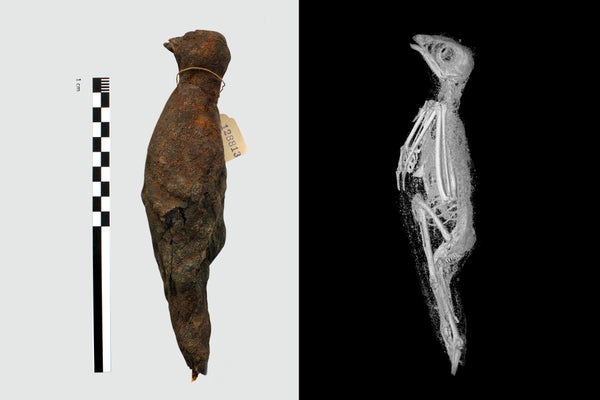
More than 2,000 years ago in Egypt, animals were often mummified as offerings to gods or buried along with human mummies. But many details about the practice are unclear, in part because studying the creatures without damaging them is difficult. Recent Micro CT scans of three animal mummies at Swansea University in Wales offered a more detailed view than ever before. The three-dimensional x-ray images—with 100 times the resolution of a regular medical CT scan—allowed researchers to precisely measure the lengths of the animals’ bones and other features. They reported their findings in August 2020 in the journal Scientific Reports. A cat mummy, for instance, turned out to be a kitten less than five months old, which might have been strangled to death. Measurements of bones in a bird mummy suggest the animal was probably a Eurasian kestrel. And a snake, identified via the scans as a juvenile Egyptian cobra, seems to have been killed by a whipping motion, and its kidneys showed signs that it had been deprived of water during its life. The images also revealed that the snake’s jaw was wide open, and there was trauma in its teeth and jaw bones, suggesting the mouth might have been pried apart during the mummification process. This is the first time such a complex ritualistic process has been documented in a snake, the researchers say.

Science in Images

Clara Moskowitz is chief of reporters at Scientific American, where she covers astronomy, space, physics and mathematics. She has been at Scientific American for more than a decade; previously she worked at Space.com. Moskowitz has reported live from rocket launches, space shuttle liftoffs and landings, suborbital spaceflight training, mountaintop observatories, and more. She has a bachelor’s degree in astronomy and physics from Wesleyan University and a graduate degree in science communication from the University of California, Santa Cruz.

More by Clara Moskowitz

It’s Time to Stand Up for Science

If you enjoyed this article, I’d like to ask for your support. Scientific American has served as an advocate for science and industry for 180 years, and right now may be the most critical moment in that two-century history.

I’ve been a Scientific American subscriber since I was 12 years old, and it helped shape the way I look at the world. SciAm always educates and delights me, and inspires a sense of awe for our vast, beautiful universe. I hope it does that for you, too.

If you subscribe to Scientific American, you help ensure that our coverage is centered on meaningful research and discovery; that we have the resources to report on the decisions that threaten labs across the U.S.; and that we support both budding and working scientists at a time when the value of science itself too often goes unrecognized.

In return, you get essential news, captivating podcasts, brilliant infographics, can't-miss newsletters, must-watch videos, challenging games, and the science world's best writing and reporting. You can even gift someone a subscription.

There has never been a more important time for us to stand up and show why science matters. I hope you’ll support us in that mission.

Thank you,

David M. Ewalt, Editor in Chief, Scientific American

Subscribe