
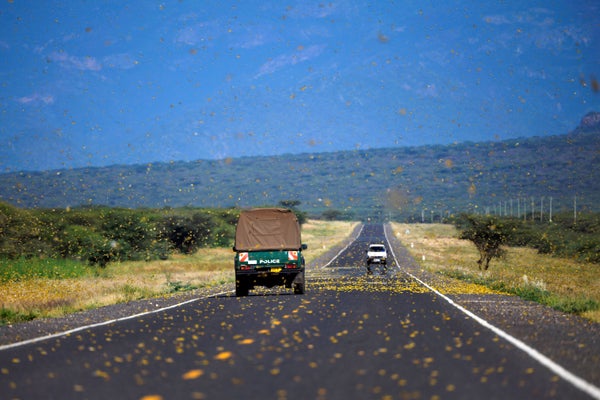
Locust swarms of biblical proportions are threatening crops across a wide swath of Africa and southwest Asia—spurring alarm among top international officials.
A major concern is famine. The United Nations is warning that mass swarms of desert locusts are endangering food supplies in eastern Africa. In response, officials in Rome mobilized an emergency briefing yesterday in a bid to raise money—noting the situation has a high potential to devolve into a full-blown crisis.
“This is an unprecedented situation that we are facing,” said Dominique Burgeon, an emergency services director at the U.N. Food and Agriculture Organization.
On supporting science journalism
If you're enjoying this article, consider supporting our award-winning journalism by subscribing. By purchasing a subscription you are helping to ensure the future of impactful stories about the discoveries and ideas shaping our world today.
He said the locust infestation in Africa is now FAO’s top priority.
FAO Director-General Qu Dongyu said he delivered a personal plea for help to U.S. Secretary of Agriculture Sonny Perdue and received assurances of support from the United States. The U.S. Agency for International Development says it released $800,000 to support FAO’s response in eastern Africa.
Cyclones that struck the driest parts of the Arabian Peninsula last year triggered the current crisis, creating ideal conditions for the desert locust species to multiply. Left to breed in isolated corners of Saudi Arabia and Yemen, the locust swarms crossed to the Horn of Africa where they were given further support by another cyclone.
More breeding cycles are expected. The swarms increase in size twentyfold with each successive generation and could reach India by June.
U.N. Secretary-General António Guterres took to Twitter yesterday in an effort to draw global attention to the worsening outbreak. The swarms are now threatening farms in parts of Ethiopia, Kenya and Somalia but are expected to spread to neighboring countries soon.
The U.N. chief pinned blame for the crisis squarely on global warming. “Desert locusts are extremely dangerous,” Guterres wrote. “Triggered by the climate crisis, the outbreak is making the dire food security situation in East Africa even worse.”
The desert locust is a particularly ravenous species that can eat its own weight in food every day. Swarms easily consume entire fields and form mass clouds large enough to block out the sun. They’re quick, too—moving up to 150 kilometers in a day.
“It’s certainly the most dangerous migratory pest in the world, desert locust,” said Keith Cressman, FAO’s senior agriculture officer. “A swarm the size of Rome can eat enough food in one day as everybody in Kenya.”
“The next growing season is around the corner,” Cressman added. “That will coincide with a new generation of swarms, so here we have a tremendous threat.”
Cressman said governments are trying to contain the swarms with aerial and ground spraying but noted that one such effort in Ethiopia was overwhelmed by the massive size of the swarms.
Cressman said FAO is now classifying the situation as “an upsurge, which is one step before a full plague.”
The United Nations’ Central Emergency Response Fund has already authorized a release of $10 million to help governments contain the infestation. FAO is seeking at least $70 million in additional aid and insist the money is needed immediately.
The situation is now the worst they’ve seen in 25 years “and the worst Kenya has seen for 70 years,” CERF administrators added.
In Rome, FAO’s top leadership said the situation calls for immediate international attention. They promised regular briefings and have scheduled another update Monday in Geneva.
“It’s a very critical time,” Qu said. “The international community should act as quickly as possible.”
Reprinted from Climatewire with permission from E&E News. E&E provides daily coverage of essential energy and environmental news at www.eenews.net.