
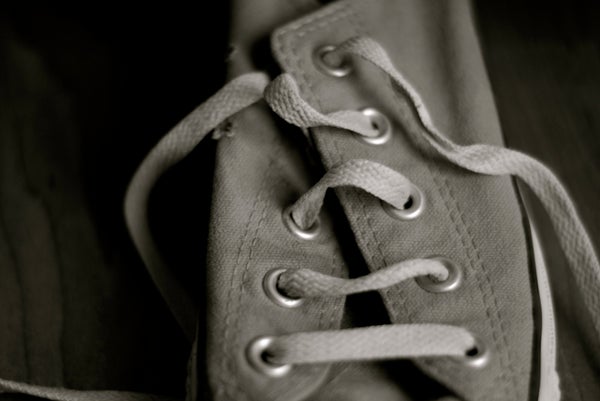
Oliver O’Reilly was teaching his daughter to tie her shoes when he realized something: he had no idea why shoelaces suddenly come undone. When he went looking for an answer, it was apparent that no one else knew either.
So O’Reilly, a mechanical engineer at the University of California, Berkeley, roped in two of his colleagues to help work it out. In a paper published on April 11 in Proceedings of the Royal Society A, they show that a combination of forces act on shoelace knots to cause a sudden, runaway failure.
The scientists expected that the knots would come undone slowly. But their slow-motion footage—focused on the shoelaces of a runner on a treadmill—showed that the knots rapidly failed within one or two strides. To figure out why, O’Reilly and his colleagues used an accelerometer on the tongue of a shoe to measure the forces acting on a knot. They found that when walking, the combined impact and acceleration on a shoelace totals a whopping 7 gs—about as much as an Apollo spacecraft on reentry to Earth’s atmosphere.
On supporting science journalism
If you're enjoying this article, consider supporting our award-winning journalism by subscribing. By purchasing a subscription you are helping to ensure the future of impactful stories about the discoveries and ideas shaping our world today.
Further experiments demonstrated that simply stomping up and down wasn’t enough for a knot to fail; neither was swinging it back and forth. It took the interlaced effects of the two forces to undo the knot: the repeated impacts loosened it while the changes of direction pulled on the laces.
Watch where you step
This interest in why knots come untied is more than purely academic, says Khalid Jawed, a mechanical engineer at Carnegie Mellon University in Pittsburgh, Pennsylvania.
Shoelace knots are the simplest type of knot, called the trefoil, he says. Most of the commonly used knots are usually just a combination of trefoils. “If we understand how simple knots work and fail, we can understand more complex knots,” he says.
This could help to create better surgeon’s knots and stronger fibres—and even unravel the reasons why deep-sea optic cables become tangled and break. It could also improve how computer animators mimic the movement of hair because it moves and twists in a similar way to strings and knots.
O’Reilly encourages people to make their own observations the next time they walk or run. They could tie one shoe with a granny knot and the other with a sturdier reef or square knot and see how their laces fare. But tread carefully: you don’t want to trip.
This article is reproduced with permission and was first published on April 12, 2017.