
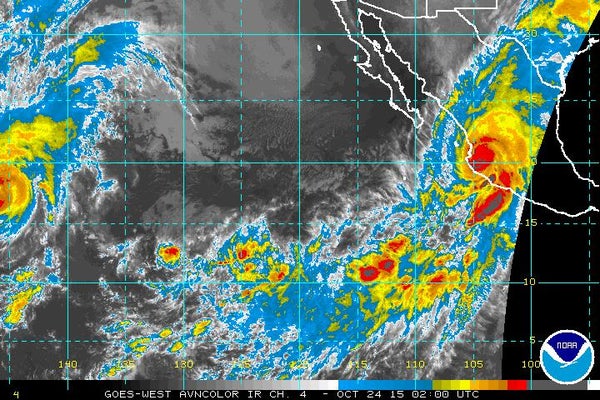
PUERTO VALLARTA, Mexicon—Hurricane Patricia, one of the most powerful storms on record, struck Mexico's Pacific coast on Friday with destructive winds that tore down trees, moved cars and forced thousands of people to flee homes and beachfront resorts.
With winds of 160 miles per hour (266 km per hour), the Category 5 hurricane had western Mexico on high alert, with the popular resort of Puerto Vallarta and others on the coast opening emergency shelters as hotels were closed. Driving rains sparked flash flooding and tourists piled into makeshift dormitories to avoid Patricia, compared by the World Meteorological Organization (WMO) to Typhoon Haiyan, which killed thousands of people in the Philippines in 2013.
"The winds are really strong. It's amazing, even the cars are moving," said Laura Barajas, a 30-year-old hotel worker from the major cargo port of Manzanillo near where the storm hit.
On supporting science journalism
If you're enjoying this article, consider supporting our award-winning journalism by subscribing. By purchasing a subscription you are helping to ensure the future of impactful stories about the discoveries and ideas shaping our world today.
There were no initial reports of casualties after the storm hit northwest of Manzanillo. The U.S. National Hurricane Center said Patricia could dissipate on Saturday as its winds will be sapped by the mountains of western Mexico.
In Puerto Vallarta, the heart of a string of resorts that range from low-end mega hotels to exclusive villas attracting tech billionaires and pop stars, loudspeakers had blared orders to evacuate hotels ahead of Patricia's arrival. The streets emptied as police sirens wailed. U.S. weather experts said Patricia was the strongest storm yet registered in the Western Hemisphere, and said the unprecedented hurricane could have a catastrophic impact.
Mexican President Enrique Pena Nieto said it was hard to predict what damage would be done by the massive storm, which could be seen barreling into Mexico from outer space. "But one thing we're certain of is that we're facing a hurricane of a scale we've never ever seen," he said.
Writing from 249 miles (401 km) above Earth on the International Space Station, U.S. astronaut Scott Kelly tweeted an imposing image of the giant storm along with the message: "Stay safe below, Mexico."
Patricia began the day blowing winds of up to 200 mph (322 kph) but was weakening noticeably as it hit the coast. U.S. President Barack Obama said the United States was standing by to help Mexico.
Officials said 15,000 domestic and foreign tourists were evacuated from Puerto Vallarta. The government warned that ash and other material from the volcano of Colima, about 130 miles (210 km) from Puerto Vallarta, could combine with massive rainfall to trigger "liquid cement"-style mudflows that could envelop nearby villages.
The storm hit the coast near Punta Perula, where fear among residents was palpable before impact. Shortly afterwards, local hotel worker Armando Cervantes said the winds were high. "I'm calm, but I still haven't been able to talk to my family," the 17-year-old Cervantes said by phone.
In Puerto Vallarta, some visitors were phlegmatic before Patricia struck. "It's natural to be worried, and then you breathe and it's gone," said Carolyn Songin, 52, a California resident visiting her friend Judith Roth, who owns a nearby yoga retreat. Roth, a 66-year-old California native, said she would ride out the storm at Songin's "bunker-like" apartment. "We're set up, we have our food and water, and we're just going to be in meditation and sending prayers for the area."
As Patricia was bearing down on the coast, traffic stretched way out of Puerto Vallarta en route to Guadalajara, Mexico's second-biggest city and around five hours drive inland.
The storm's potential to wreak havoc is immense. "The winds are enough to get a plane in the air and keep it flying," WMO spokeswoman Clare Nullis told a U.N. briefing in Geneva early on Friday, likening Patricia to Typhoon Haiyan. That storm killed over 6,300 people and wiped out or damaged nearly everything in its path on Nov. 8, 2013, destroying around 90 percent of the city of Tacloban.
The strongest storm ever recorded was Cyclone Tip which hit Japan in 1979.