
In the summer of 1989, from a remote expanse of our solar system where sunlight is merely a tepid glow, NASA's
Voyager 2 spacecraft radioed to Earth humankind's very first images of Neptune. The pictures revealed the sun's outermost planet was a stunning, deep blue orb. In contrast, Uranus, Neptune's planetary neighbor and the first to be discovered with a telescope, appeared noticeably paler.
Both seemingly twin worlds have a lot in common. They're roughly the same size, almost equally massive and are both enveloped with deep atmospheres made of similar materials. So why were the two orbs different shades of blue? This is a question that has puzzled scientists for decades.
On supporting science journalism
If you're enjoying this article, consider supporting our award-winning journalism by subscribing. By purchasing a subscription you are helping to ensure the future of impactful stories about the discoveries and ideas shaping our world today.
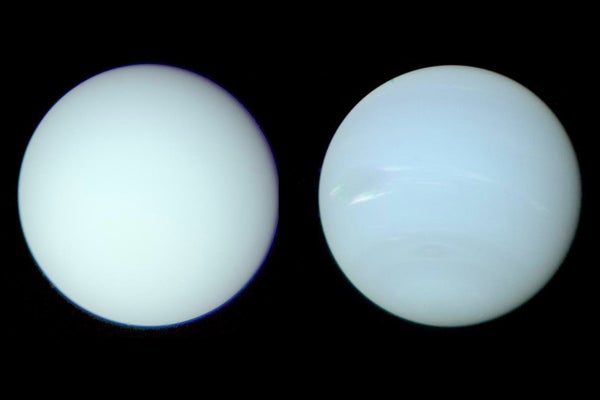
Now, however, a fresh analysis of Voyager 2's images show both ice giants are in fact a similar shade of greenish blue, which is the "most accurate representation yet" of the planets' colors, the new study finds.
How could we miss this?
Back in the late 1900s, the images Voyager 2 recorded of Uranus and Neptune were in single colors combined to create composite images that showed the planets to be cyan and azure, respectively. While Uranus' published pictures were processed close to its true color, early Neptune images had been "stretched and enhanced" to display its clouds, bands and winds, "and therefore made artificially too blue," study lead author Patrick Irwin, a planetary physicist at the Oxford University in the U.K., said in a statement.
"Even though the artificially-saturated color was known at the time amongst planetary scientists — and the images were released with captions explaining it — that distinction had become lost over time."
To resolve the misconception, Irwin and colleagues used new images from NASA's Hubble Space Telescope and European Space Agency's Very Large Telescope, whose instruments capture a rich spectrum of colors in each pixel, so processing them determined the "true apparent colors" of Uranus and Neptune.
Then, the team revisited Voyager 2's images and rebalanced them in line with the new data, showing both planets are actually similar shades of blue. The color comes from a layer of methane in the planets' atmospheres, which absorbs red color from the sun's light.
Uranus is slightly whiter, the new study finds, possibly because its somewhat "stagnant, sluggish" atmosphere
permits the methane haze to accumulate, which reflects red portions of sunlight to a greater extent than Neptune does.
The presence of amassed methane ice particles may also explain why Uranus changes its color slightly during its 84-year orbit around the sun. Images recorded between 1950 and 2016 by the Lowell Observatory in Arizona show the planet appears greener during its solstices — when one of its poles points toward the sun — and bluer during equinoxes, when the sun shines directly above its equator.
By comparing brightness of Uranus' poles to its equatorial regions in these images, Irwin and his team concluded methane is likely half as abundant near poles than at the equator, which accounts for the changing colors.
"The misperception of Neptune's color, as well as the unusual color changes of Uranus, have bedeviled us for decades," said Heidi Hammel of the Association of Universities for Research in Astronomy, who is not affiliated with the new study. "This comprehensive study should finally put both issues to rest."
This research is described in a paper published Thursday (Jan. 4) in the journal Monthly Notices of the Royal Astronomical Society.
Copyright 2023 Space.com, a Future company. All rights reserved. This material may not be published, broadcast, rewritten or redistributed.