
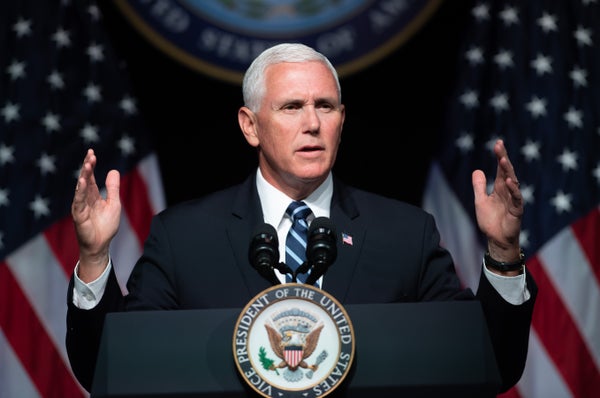
Today (Aug. 9), Vice President Mike Pence unveiled a detailed plan for the military Space Force proposed by President Donald Trump in a speech at the Pentagon. If Congress agrees to establish it, the Space Force will be the sixth branch of the U.S. military.
The Department of Defense is expected to release a report later today "outlining the first stages of our administration's plan to implement the president's guidance and turn his vision into a reality," Pence said. "This report reviews the national security space activities within the Department of Defense, and it identifies concrete steps that our administration will take to lay the foundation for a new department of the Space Force." [The Most Dangerous Space Weapons Ever]
During his speech, Pence outlined four specific actions the Trump administration sees as the fundamental first steps in creating the Space Force. Those steps involve the creation of:
On supporting science journalism
If you're enjoying this article, consider supporting our award-winning journalism by subscribing. By purchasing a subscription you are helping to ensure the future of impactful stories about the discoveries and ideas shaping our world today.
a new U.S. Space Command, which "will establish unified command control for our Space Force operations; ensure integration across the military; and develop the space war fighting doctrine, tactics, techniques and procedures of the future," Pence said.
a military astronaut corps, which Pence called "an elite group of joint war fighters specializing in the domain of space."
a Space Development Agency, which will research and develop new technologies and "ensure cutting-edge war-fighting capabilities."
new bureaucratic structures that will define "clear lines of responsibility and accountability to manage the process of standing up and scaling up the United States Department of the Space Force."
The Trump administration aims to have the Space Force up and running by 2020, Pence said. "Next February in the president's budget, we will call on the Congress to marshal the resources we need to stand up."
Trump's Space Force has stirred plenty of controversy and debate since the President first publicly entertained the idea during a speech in March 2018, when he told U.S. service members that his "new national strategy for space recognizes that space is a war-fighting domain, just like the land, air and sea."
On June 18, Trump showed that he was serious about the Space Force by formally directing the Pentagon to create the new military branch. "We are going to have the Space Force," he said during a meeting of the National Space Council.
It's going to take a lot more than a few grandiose speeches from Trump and Pence in order for the Space Force idea to come to fruition, though. Only Congress has the authority to establish a new branch of the military—something that hasn't happened since the U.S. Air Force was founded in 1947. So, before we can "have the Space Force," as Trump put it, the White House will have to convince lawmakers that the U.S. really needs it.
Critics argue that Trump's Space Force would be stepping on the toes of the U.S. Air Force Space Command, which currently oversees the nation's military operations in space. Air Force officials and national security experts have spoken out against the creation of a separate Space Force.
Meanwhile, others have argued that it makes sense to form a separate military branch specifically for space. "It is becoming a contested war-fighting domain, and we've got to adapt to that reality," U.S. Secretary of Defense Jim Mattis said in his opening remarks before Pence's speech.
"Our nation's armed forces have always been the vanguard of advancing American leadership here on Earth and beyond," Pence said. "The Space Force is the next and natural evolution of American military strength."
Copyright 2018 SPACE.com, a Purch company. All rights reserved. This material may not be published, broadcast, rewritten or redistributed.