
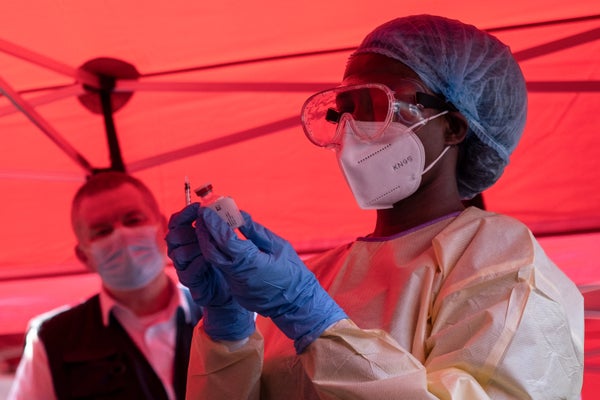
Around 50 confirmed Ebola cases, 600 suspected cases and 130 suspected deaths are now under investigation in the Democratic Republic of the Congo (DRC) and Uganda as health officials race to contain a fast-expanding outbreak caused by the rare Bundibugyo species of Ebola virus. Cases have also been detected in the major Congolese cities of Goma and Bunia, raising fears of wider spread.
Experts are working on several vaccine candidates for Bundibugyo, including an mRNA vaccine, but they aren’t available yet.
“This species of Ebola is one for which there is no licensed vaccine or treatment,” Anne Ancia, the World Health Organization representative in the DRC, said in a press briefing Tuesday.
On supporting science journalism
If you're enjoying this article, consider supporting our award-winning journalism by subscribing. By purchasing a subscription you are helping to ensure the future of impactful stories about the discoveries and ideas shaping our world today.
There are six known Ebola virus species, four of which are known to cause disease in humans. But Bundibugyo virus has caused relatively few outbreaks historically and has remained a lower research priority compared with the more lethal Zaire strain or even Marburg virus, which belongs to the same viral family as Ebola.
“Most of Ebola countermeasure development has been focused on Ebola Zaire, which was traditionally the more deadly strain and has always been the more common strain behind outbreaks,” says Amesh Adalja, a senior scholar at the Johns Hopkins Center for Health Security. “That also means that a lot of the other Ebola strains have not necessarily had that same level of vaccine development.”
“Ideally, what you’d want is kind of a universal filovirus [the family that contains Ebola and Marburg viruses] vaccine that works against all the strains of Ebola, as well as the Marburg strains. I think that would be the holy grail here.”
Considering mRNA Vaccines
The outbreak has reignited interest in mRNA vaccines, which transformed the global response to COVID.
Shanelle Hall, principal adviser to the Africa Centers for Disease Control and Prevention’s director-general on management and operations, said in a press briefing that experimental vaccines and therapeutics against the Bundibugyo strain, including the monoclonal antibody DP134 and remdesivir-based treatments, are being considered for use under randomized controlled trial protocols in the DRC and Uganda, though none have yet commenced.
The agency is also reviewing several vaccine candidates, including the live non-mRNA vaccine Ervebo, which has been used for Ebola Zaire outbreaks, alongside earlier-stage Bundibugyo-focused candidates from Moderna, the University of Oxford and the International AIDS Vaccine Initiative. The inclusion of Moderna’s vaccine among the candidates under review has also renewed attention on whether mRNA technologies could eventually help close longstanding gaps in preparedness for rarer Ebola species. “The scientists are reviewing these to come up with accelerated plans and then protocols for looking at effectiveness of cross-protection between strains,” she says.
Regarding mRNA vaccines, Adalja says that “because of the speed with which they can be manufactured, the speed with which they can be adapted, these should be very near the top of the list when you’re thinking about vaccine development for emerging pathogens like strains of Ebola that we don’t have vaccines for.”
The Coalition for Epidemic Preparedness Innovations (CEPI), a nonprofit that funds vaccine development, said it is assessing vaccine and antibody drug candidates that could potentially be evaluated during the outbreak. “Currently, there are no Bundibugyo-specific vaccine candidates in phase 1 [early-stage] clinical trials, but several are in preclinical development [animal studies],” Nicole Lurie, CEPI’s executive director for preparedness and response, said in a statement.
CEPI said it has activated an internal emergency response team to coordinate scientific, funding and vaccine development efforts linked to the outbreak. It is also exploring ways to rapidly advance vaccine candidates and identify manufacturers capable of producing doses for clinical trials for the current outbreak.
Public health experts have also called for a broader “prototype pathogen” or viral family approach to preparedness, in which scientists develop countermeasures that target “conserved” features shared across related viruses rather than focusing on one strain at a time. “I’ve been somebody that’s advocated for a viral family approach for some time. Think about the viral family as a whole,” Adalja says.