New Issue: Orbital Catastrophe Ahead? Read Now

Venus Flytrap Inspires New Material That Snaps Back into Shape

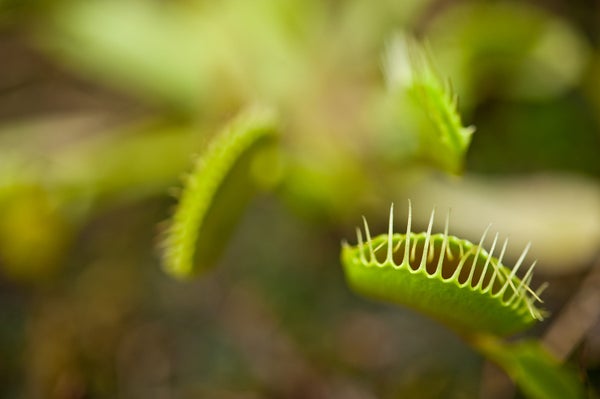
Like the plant, a three-layered hydrogel can change shape then quickly return to original position

venus flytrap

Inspired by carnivorous plant’s movement, researchers have been designing polymers that rapidly change shape in response to external stimuli.

Join Our Community of Science Lovers!

Scientists in China have designed a smart material that rapidly switches from one shape to anotherjust like a Venus flytrap plant snaps close when trapping prey.

Inspired by carnivorous plant’s movement, researchers have been designing polymers that rapidly change shape in response to external stimuli. However, the snapping process is usually irreversible, which has so far limited the materials’ practical potential.

Courtesy of ChemistryWorld


On supporting science journalism

If you're enjoying this article, consider supporting our award-winning journalism by subscribing. By purchasing a subscription you are helping to ensure the future of impactful stories about the discoveries and ideas shaping our world today.


Tao Xie and co-workers from Zhejiang University have now created a hydrogel-based system that is the first to undergo reversible snapping. The assembly comprises layers of three dissimilar hydrogels: a non-responsive, a thermo-responsive and a pH-responsive one, which are held together with a supramolecular glue. This allows the material to react to pH or temperature changes and switch between two shapes (eg convex and concave disk).

Xie and co-workers suggest that the rapid snapping mechanism could be extended to other shape-changing materials, such as shape memory polymers and liquid crystalline elastomers.

This article is reproduced with permission from Chemistry World. The article was first published on July 28, 2016.

Subscribe to Support Independent Journalism

Great science journalism requires human expertise, time, effort and creativity. And it costs money. That’s why I and the journalists here at Scientific American hope you’ll join our community.

When you subscribe, you are supporting staff and freelance journalists who are passionate about telling science stories that are true, important and compelling. Our editors and reporters are often experts in their fields, which means they understand the nuances of big discoveries and can untangle the breakthroughs from the hype. With a subscription, you are also supporting rigorous fact-checking to ensure the words we publish are precise and accurate. And you’re supporting original illustrations, graphics and photos that bring you closer to an advanced laboratory, an ice sheet in Antarctica or a space mission in orbit. You’re helping us craft other types of high-quality journalism as well: Our newsletters are carefully written, edited and curated by staffers you have or will come to know and love. Our Science Quickly podcast is based on original reporting, collaboration with editors and scientists and exacting production.

Subscriptions keep this engine running so we can continue to deliver thoughtful, rigorous and independent science journalism to you. In an era of viral misinformation, this work is crucial. If you value what we do, I hope you’ll consider joining us as a subscriber

Thank you,

Jeanna Bryner, Editor in Chief, Scientific American

Subscribe