
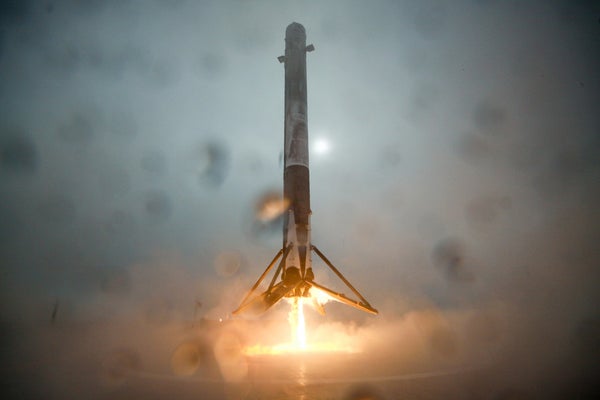
A video posted late Sunday by billionaire Elon Musk shows just how close his spaceflight company SpaceX came to landing its Falcon 9 rocket on a robotic platform parked in the Pacific Ocean on January 17.
The short video, which Musk posted on Instagram, shows the Falcon 9 rocket first stage touching down on the drone ship as planned, but then falling over to hit the deck and explode. Musk has said one of the four landing legs on the rocket failed to latch securely, leading to the fall. The rocket landing occured after SpaceX successfully launched the Jason-3 satellite into orbit from Vandenberg Air Force Base in California. The satellite will map Earth's oceans in unprecedented detail for NASA and NOAA.
"Falcon lands on droneship, but the lockout collet doesn't latch on one the four legs, causing it to tip over post landing," Musk wrote on his Instagram post accompanying the video. "Root cause may have been ice buildup due to condensation from heavy fog at liftoff." [See more photos from SpaceX's rocket landing and Jason-3 launch]
On supporting science journalism
If you're enjoying this article, consider supporting our award-winning journalism by subscribing. By purchasing a subscription you are helping to ensure the future of impactful stories about the discoveries and ideas shaping our world today.
Thick, persistent fog blanketed SpaceX's launch site at Vandenberg throughout the countdown to the Jason-3 launch on Sunday. The mission blasted off at 1:42 p.m. EST (10:42 a.m. PST/1842 GMT). SpaceX's droneship "Just Read The Instructions" was stationed about 200 miles (320 kilometers) west of San Diego during the landing attempt.
Last month, SpaceX successfully landed a Falcon 9 rocket on dry land at its Landing Site 1 pad based at the Cape Canaveral Air Force Base in Florida. That rocket landing followed the successful launch of 11 ORBCOMM communications satellites by the same booster. SpaceX also attempted droneship rocket landings several times in 2015 in the Atlantic Ocean, but was unsuccessful.
SpaceX and Elon Musk have been pursuing reusable rocket technology in order to drive down the cost of spaceflight. SpaceX hopes to launch, land and refly the first stage of a Falcon 9 rocket by the end of 2016. The company is aiming to develop a completely reusable launch vehicle as part of its goal of eventually reaching Mars.
Another private spaceflight company, Blue Origin founded by Amazon CEO Jeff Bezos, is also pursuing reusable rocket technology with vertical landings like SpaceX. Last November, the company launched its suborbital New Shepard rocket and landed it on a pad at its West Texas test site.
Blast-Off! SpaceX Launches Jason-3 Satellite Through Fog | Video
Inside SpaceX's Epic Fly-back Reusable Rocket Landing (Infographic)
Copyright 2016 SPACE.com, a Purch company. All rights reserved. This material may not be published, broadcast, rewritten or redistributed.