
Vintage Scientific American Covers by Fish Illustrator Stanley Meltzoff

The latest science book recommendations from our editors

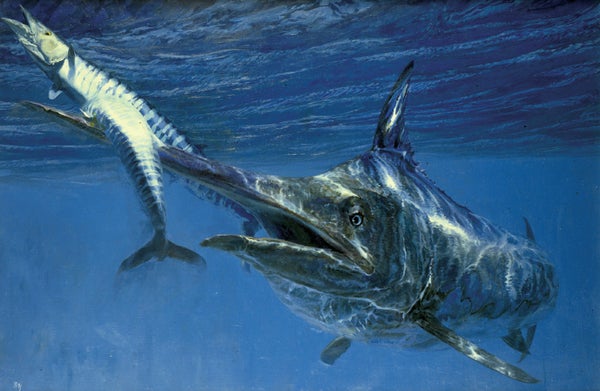
Black Marlin and Two Wahoo

Black Marlin and Two Wahoo, 1980s. Oil on mounted canvas.

© 2020 Silverfish Press

Join Our Community of Science Lovers!

For the first century of its existence, Scientific American was primarily a listing of the latest inventions and patents. But in 1948, the magazine was sold and the new owners wanted to reimagine the publication's mission, hoping to make it more timely and authoritative. As part of this rebranding, they hired freelance artist Stanley Meltzoff to illustrate their covers. A graduate of the Institute of Fine Arts at New York University, Meltzoff had worked as an art director and journalist for an army newspaper during World War II. Afterward he made images for advertising agencies in Manhattan and paperback book covers. His work for Scientific American, a total of 65 covers, launched his career as a magazine illustrator, and he went on to create images for Life, National Geographic and Argosy. Meltzoff died in 2006 at age 89.

Scientific American covers (left to right): Photosynthesis, August 1948; Insect Metamorphosis, April 1950; Fruit Fly and Needle, October 1949. Credit: Scientific American


On supporting science journalism

If you're enjoying this article, consider supporting our award-winning journalism by subscribing. By purchasing a subscription you are helping to ensure the future of impactful stories about the discoveries and ideas shaping our world today.


Meltzoff's paintings, memorialized in this mesmerizing collection, were all done by hand, mostly as oil on board or canvas. He became an avid scuba diver and painted fish and undersea life, which became his most famous artworks. In the autobiography that accompanies the images, Meltzoff adamantly calls himself simply a “picture maker,” believing that the practical, photorealistic nature of his work did not qualify as the higher-minded creativity of an “artist.” But to examine the images in this collection, it's hard not to feel that he was mistaken.

Scientific American cover: Bird Flight, April 1952. Credit: © 2020 Silverfish Press

Stanley Meltzoff poses under the sea, 1969. Credit: © 2020 Silverfish Press

Andrea Gawrylewski is chief newsletter editor at Scientific American. She writes the daily Today in Science newsletter and oversees all other newsletters at the magazine. In addition, she manages all special editions and in the past was the editor for Scientific American Mind, Scientific American Space & Physics and Scientific American Health & Medicine. Gawrylewski got her start in journalism at the Scientist magazine, where she was a features writer and editor for "hot" research papers in the life sciences. She spent more than six years in educational publishing, editing books for higher education in biology, environmental science and nutrition. She holds a master's degree in earth science and a master's degree in journalism, both from Columbia University, home of the Pulitzer Prize.

More by Andrea Gawrylewski
Scientific American Magazine Vol 323 Issue 1This article was published with the title “Recommended” in Scientific American Magazine Vol. 323 No. 1 (), p. 68
doi:10.1038/scientificamerican0720-68

It’s Time to Stand Up for Science

If you enjoyed this article, I’d like to ask for your support. Scientific American has served as an advocate for science and industry for 180 years, and right now may be the most critical moment in that two-century history.

I’ve been a Scientific American subscriber since I was 12 years old, and it helped shape the way I look at the world. SciAm always educates and delights me, and inspires a sense of awe for our vast, beautiful universe. I hope it does that for you, too.

If you subscribe to Scientific American, you help ensure that our coverage is centered on meaningful research and discovery; that we have the resources to report on the decisions that threaten labs across the U.S.; and that we support both budding and working scientists at a time when the value of science itself too often goes unrecognized.

In return, you get essential news, captivating podcasts, brilliant infographics, can't-miss newsletters, must-watch videos, challenging games, and the science world's best writing and reporting. You can even gift someone a subscription.

There has never been a more important time for us to stand up and show why science matters. I hope you’ll support us in that mission.

Thank you,

David M. Ewalt, Editor in Chief, Scientific American

Subscribe