Virgin Orbit’s First Launch of 2021 Is Imminent

The company is targeting Sunday, January 17 for sending its LauncherOne rocket to space from the belly of a 747 jet

Cosmic Girl

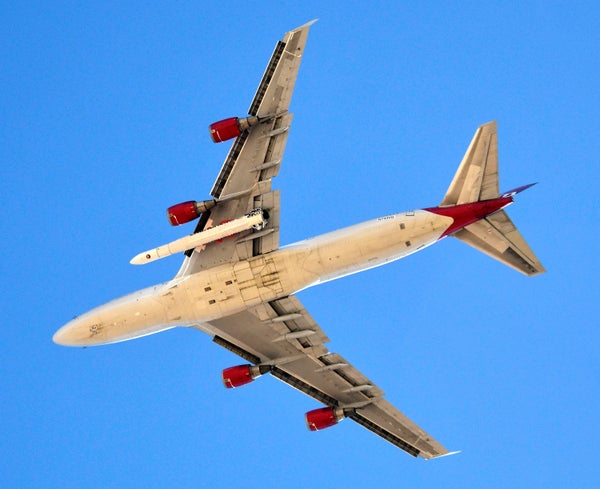
“Cosmic Girl,” Virgin Orbit’s spacecraft-carrying 747 airplane, shortly after takeoff during a test run in June 2019. The company’s “LauncherOne” rocket can be seen mounted beneath Cosmic Girl’s left wing.

Join Our Community of Science Lovers!

We’ll have to wait until this weekend to see Virgin Orbit take another crack at reaching space.

The company is now targeting Sunday (Jan. 17) for Launch Demo 2, its second attempt to reach orbit with its air-launched LauncherOne rocket.  (The booster didn’t make it on its first try, which occurred in May 2020.)

If all goes according to plan, Virgin Orbit’s carrier plane, Cosmic Girl, will lift off from California’s Mojave Air and Space Port on Sunday during a four-hour window that opens at 1 p.m. EST (1800 GMT; 10 a.m. local time in California), with LauncherOne tucked beneath one wing. 


On supporting science journalism

If you're enjoying this article, consider supporting our award-winning journalism by subscribing. By purchasing a subscription you are helping to ensure the future of impactful stories about the discoveries and ideas shaping our world today.


At an altitude of about 35,000 feet (10,700 meters), LauncherOne will drop free and make its own way to orbit. You can follow the mission’s progress via Virgin Orbit’s Twitter feed.

Virgin Orbit had been eyeing mid-December for Launch Demo 2, but complications arising from the ongoing coronavirus pandemic pushed the date to Jan. 10. Last week, the company announced that the target had slipped to Jan. 13. And we got another update on Tuesday (Jan. 12).

“Our Launch Readiness Review is complete, our hardware looks great, and our customers are ready. We’re following through on the last actions identified at our LRR. Our launch is now targeted for NET [no earlier than] Sunday, Jan. 17, with additional windows in January if needed,” Virgin Orbit said via Twitter on Tuesday (Jan. 12).

You can read more about Launch Demo 2 in our preview story from last week.

Copyright 2020 Space.com, a Future company. All rights reserved. This material may not be published, broadcast, rewritten or redistributed.

Mike Wall has been writing for Space.com since 2010. His book about the search for alien life, “Out There,” was published on Nov. 13, 2018. Before becoming a science writer, Michael worked as a herpetologist and wildlife biologist. He has a Ph.D. in evolutionary biology from the University of Sydney, Australia, a bachelor’s degree from the University of Arizona, and a graduate certificate in science writing from the University of California, Santa Cruz.

More by Mike Wall

SPACE.com is the premier source of space exploration, innovation and astronomy news, chronicling (and celebrating) humanity's ongoing expansion across the final frontier.

More by SPACE.com

It’s Time to Stand Up for Science

If you enjoyed this article, I’d like to ask for your support. Scientific American has served as an advocate for science and industry for 180 years, and right now may be the most critical moment in that two-century history.

I’ve been a Scientific American subscriber since I was 12 years old, and it helped shape the way I look at the world. SciAm always educates and delights me, and inspires a sense of awe for our vast, beautiful universe. I hope it does that for you, too.

If you subscribe to Scientific American, you help ensure that our coverage is centered on meaningful research and discovery; that we have the resources to report on the decisions that threaten labs across the U.S.; and that we support both budding and working scientists at a time when the value of science itself too often goes unrecognized.

In return, you get essential news, captivating podcasts, brilliant infographics, can't-miss newsletters, must-watch videos, challenging games, and the science world's best writing and reporting. You can even gift someone a subscription.

There has never been a more important time for us to stand up and show why science matters. I hope you’ll support us in that mission.

Thank you,

David M. Ewalt, Editor in Chief, Scientific American

Subscribe