
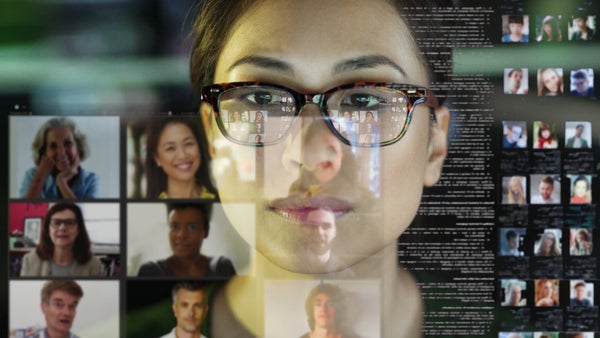
Last spring, national scientific organizations began holding conferences online in response to the coronavirus pandemic and the trend has continued into 2021. For example, the American Physical Society annual meeting was the first major physics conference to be virtual last year, and will still be held in cyberspace this coming April. In hindsight, such changes were inevitable. The uncontrolled spread of COVID-19 in the U.S. made attending large public gatherings far too risky. And who knows when the pandemic will end? When the alternative is postponement, the decision to go remote seems like a far better alternative.
While they certainly make sense against the backdrop of a global pandemic, scientists wonder how virtual meetings will alter the future of conferences. Some are worried; it’s difficult to recreate the spontaneous yet pivotal face-to-face interactions that can spur future collaborations or even job offers. But the fact of the matter is, in-person conferences only benefit those who are already privileged enough to attend. Virtual conferences have been shown to be far more inclusive. That's why disabled researchers have spent years advocating for a virtual attendance option.
In-person conferences are notoriously inaccessible, yet little has been done to rectify these issues. This has greatly limited the number of disabled and chronically ill scientists who can attend these meetings, as simply traveling to and from the venue can be an accessibility nightmare. Even when a disabled person is able to travel to the conference venue, the access barriers are still often present throughout the event.
On supporting science journalism
If you're enjoying this article, consider supporting our award-winning journalism by subscribing. By purchasing a subscription you are helping to ensure the future of impactful stories about the discoveries and ideas shaping our world today.
Take poster halls, for example. These loud, crowded environments are unfriendly to neurodivergent people, and their aisles are often too narrow to accommodate most mobility aids. Similarly, presentations and workshops may not be welcoming to attendees who are deaf or hard of hearing. Individuals with chronic illnesses may also be forced to forego important late-night networking opportunities in order to conserve enough energy for the next day's sessions. But virtual conferences can alleviate many of these issues.
“I have a bit more control,” says Michele Cooke, a geoscientist and professor at the University of Massachusetts Amherst. When content is uploaded online, Cooke, who identifies as partially deaf, can crank up the volume, run live transcription software and rewatch recordings in order to better comprehend what’s being said. Asynchronous presentations also allow audiences to tune in on their own schedules, which is key for people with dynamic disabilities. Participating remotely means disabled people can access conference material from home setups that have been painstakingly curated to be as accessible to them as possible. As a result, energy spent navigating inaccessible physical spaces can now be diverted into ... dealing with inaccessibility online.
Switching to online meetings has resulted in huge gains in accessibility, but that likely says more about how unwelcoming in-person conferences have been toward disabled people than anything else. But online meetings also have their share of problems. “I don’t think any conference I’ve been to was fully accessible [to me],” says Linda Corcoran, a master’s student at the University College Cork.
Late in 2020, accessibility oversights were still aplenty and it was especially obvious when disabled people weren’t included in the planning committee. As an example, look no further than the American Geophysical Union (AGU) Fall Meeting where the automated captioning turned portions of scientific talks into gibberish.
“Craptions,” as they’re often called, combined with recordings that don’t require presenters to keep their cameras on, prevent those who rely on captions or speech-reading from fully understanding the presentation. Those who use assistive technology, such as screen readers, also may be impeded from fully accessing conference materials; PowerPoint slides presented in videos or on Web conferencing software can’t be seen by these devices. “Having the PowerPoint available ahead of time would be nice so I can actually follow along,” says Newton Nguyen, a Ph.D. student from the California Institute of Technology. While conferences like AGU mentioned that presenters should make their materials available for blind attendees on their accessibility pages, I saw no evidence that any had been uploaded to the conference website.
Many of us are looking forward to a post-COVID world where in-person meetings are safe again, but that doesn’t necessarily mean that virtual conferences will cease to exist once the pandemic is over. They have been very well-received. More than that, they’ve opened the doors to so many groups who wouldn’t have otherwise had a chance to attend.
That said, virtual conferences are only as inclusive as they’re made to be; diversity and inclusion efforts have a long history of leaving out disabled people. Creating disability-inclusive conference spaces needs to be an active effort on the part of conference organizers. It requires basic accommodations to be proactively incorporated into the event and for disabled researchers to be involved in all aspects of the planning process. "It's a low bar," admits Corcoran. But 10 months in, many still fail to meet it.