Visualizing Climate Disasters’ Surprising Cascading Effects

See how climate disasters cause rippling effects far beyond the initial event

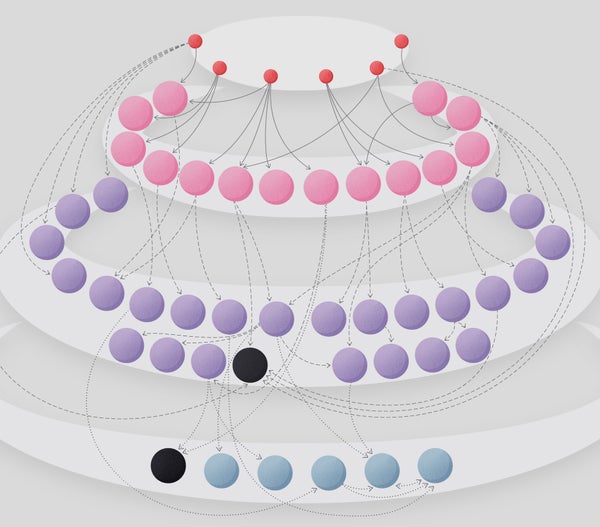
Illustration includes 4 tiers, connected by a web of arrows. Top tier includes 6 red spheres. Next tier includes 14 pink spheres. Third tier includes 26 spheres. Bottom tier includes 6 spheres.

Federica Fragapane

Join Our Community of Science Lovers!


On supporting science journalism

If you're enjoying this article, consider supporting our award-winning journalism by subscribing. By purchasing a subscription you are helping to ensure the future of impactful stories about the discoveries and ideas shaping our world today.


When people imagine the aftermath of a natural disaster, skin infections and gastrointestinal illnesses aren't usually the problems that come to mind. But these conditions are embedded in a cascade of extensive and often unexpected consequences of wildfires, hurricanes, and other calamities related to climate change. A report entitled Atlas of Disaster connects the dots between the initial effects of climate hazards and the longer-term outcomes. Most of the U.S. is already feeling the impact—90 percent of American counties experienced a climate-related disaster in the decade from 2011 to 2021, and some have seen many. The damage is even worse in numerous other parts of the world.

“Climate change is here, and our communities are suffering,” says report co-author Amy Chester, managing director of Rebuild by Design, a nonprofit founded after the devastation of Hurricane Sandy in 2012. She hopes this research will shift the national discussion away from what to do if climate disasters occur and toward what we can do now that they are happening.
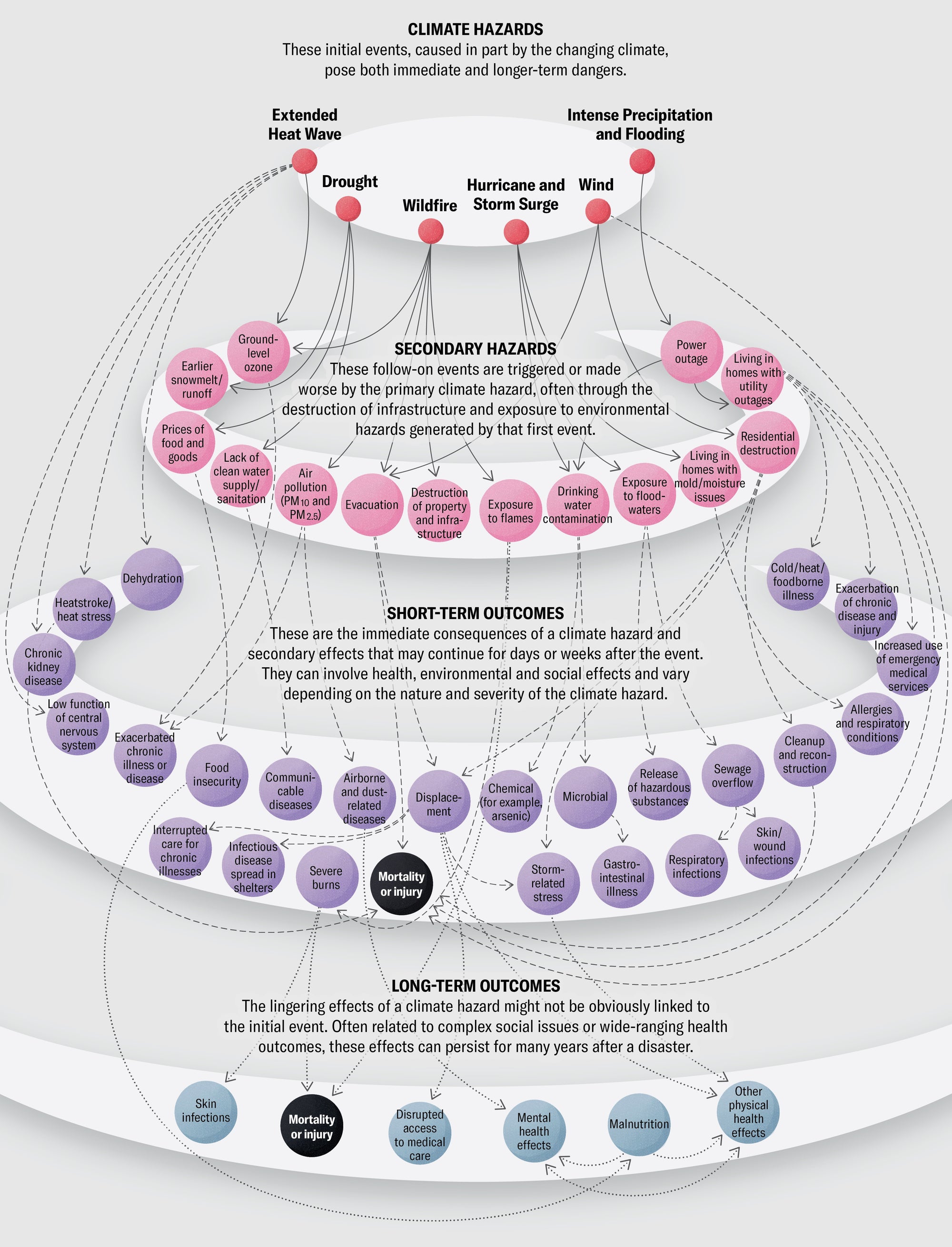
Credit: Federica Fragapane; Inspired by “Cascading Impacts of Climate Events” graphic by Geethanjali MR, in Atlas of Disaster, from Rebuild by Design; Rebuild by Design sources: Preparing for Regional Health Impacts of Climate Change in the United States, Centers for Disease Control and Prevention Climate and Health Program, July 2020; Human Health and the Climate Crisis, by Gail L. Carlson, Jones & Bartlett Learning, January 2022; “Health Effects of Coastal Storms and Flooding in Urban Areas: A Review and Vulnerability Assessment,” by Kathryn Lane et al., in Journal of Environmental and Public Health, Vol. 2013, http://dx.doi.org/10.1155/2013/913064

Lori Youmshajekian is a science journalist who reports on consumer health, environmental issues and scientific misconduct. She holds a master’s degree in science journalism from New York University and has written for National Geographic, Wired and Retraction Watch, among other outlets.

More by Lori Youmshajekian

Federica Fragapane is an independent information designer who specializes in creating projects and data visualizations as a freelancer. Many of her projects take an experimental approach, carefully selecting visual languages to encourage readers to engage with the narratives conveyed by the data. In 2023 three of her projects were acquired by the Museum of Modern Art (MoMA) in New York City, becoming part of its Permanent Collection. Her work can be found at www.be.net/federicafragapane

More by Federica Fragapane
Scientific American Magazine Vol 330 Issue 2This article was published with the title “Cascading Climate Impacts” in Scientific American Magazine Vol. 330 No. 2 (), p. 86
doi:10.1038/scientificamerican0224-86

It’s Time to Stand Up for Science

If you enjoyed this article, I’d like to ask for your support. Scientific American has served as an advocate for science and industry for 180 years, and right now may be the most critical moment in that two-century history.

I’ve been a Scientific American subscriber since I was 12 years old, and it helped shape the way I look at the world. SciAm always educates and delights me, and inspires a sense of awe for our vast, beautiful universe. I hope it does that for you, too.

If you subscribe to Scientific American, you help ensure that our coverage is centered on meaningful research and discovery; that we have the resources to report on the decisions that threaten labs across the U.S.; and that we support both budding and working scientists at a time when the value of science itself too often goes unrecognized.

In return, you get essential news, captivating podcasts, brilliant infographics, can't-miss newsletters, must-watch videos, challenging games, and the science world's best writing and reporting. You can even gift someone a subscription.

There has never been a more important time for us to stand up and show why science matters. I hope you’ll support us in that mission.

Thank you,

David M. Ewalt, Editor in Chief, Scientific American

Subscribe