
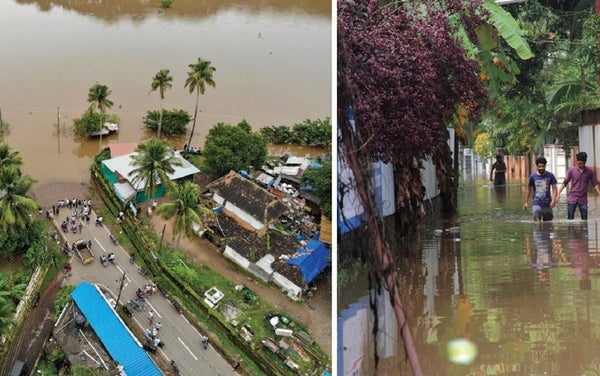
Many people view climate change as a distant, abstract threat. But having them imagine the tangible consequences of resulting droughts or floods may help shift this perception and encourage proenvironmental behavior, a new study suggests.
Researchers asked 93 college students in Taiwan to read a report on temperature anomalies, floods and other climate change-related events that have affected the island. The scientists then asked 62 of the participants to write down three ways in which such phenomena might impact their future lives. Half the people in that group were instructed to imagine such scenarios in detail, including specific individuals and settings. The remaining 31 students did not complete either the writing or imagining steps, acting as a control group.
All the participants then rated their perceptions of climate change risks by responding to prompts such as “How likely do you think it is that climate change is having serious impacts on the world?” They used a scale from 1 (“very unlikely”) to 7 (“very likely”). The average score was higher among subjects who had been asked to envision detailed scenarios than among those who had not. The results were later confirmed in a second experiment involving 102 participants.
On supporting science journalism
If you're enjoying this article, consider supporting our award-winning journalism by subscribing. By purchasing a subscription you are helping to ensure the future of impactful stories about the discoveries and ideas shaping our world today.
Individuals in the first experiment who had visualized the effects of climate change were subsequently more likely to say they would use air conditioning in an energy-saving manner. In the second experiment, nearly two thirds of people in the visualizing group signed up to help clean a beach, compared with 43 percent in the nonvisualizing one. And when offered a choice of a vegetarian or nonvegetarian lunch box, nearly half the visualizers selected the environmentally friendlier meatless option—compared with about 28 percent of the nonvisualizers, the researchers reported online in July in Environment and Behavior.
The investigators did not track people to see if they behaved differently in their day-to-day lives—something further studies should examine, says study co-author Wen-Bin Chiou, a professor of psychology at Taiwan's National Sun Yat-sen University. Moreover, the research “should be replicated in other places with other populations,” says Robert Gifford, a professor of psychology at the University of Victoria in British Columbia, who was not involved in the work.
The findings could nonetheless be applied to raise public concern about climate change, Chiou says. For example, he suggests that news reports about the phenomenon could include vivid descriptions of its effects on people's lives and ask readers to imagine experiencing such impacts. Having virtual-reality demonstrations in local science museums of the consequences of climate change would be another way of putting the research into practice, Chiou adds.