
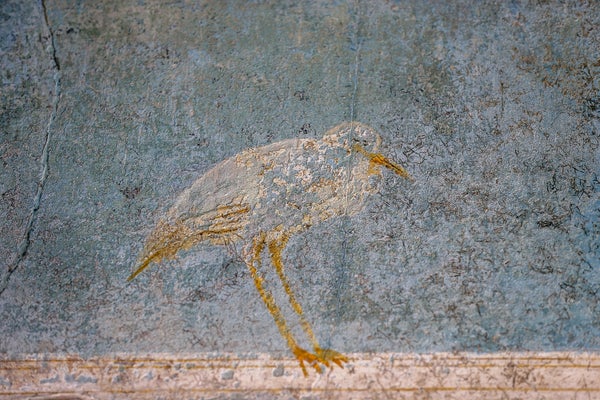
Smothered under volcanic ash and rocks from the eruption of Mount Vesuvius, the ancient city of Pompeii in modern-day Italy lay buried for more than 1,500 years before it was discovered and excavations began. Most archaeologists expect that the volcanic debris will safely preserve the remaining ruins. But new work suggests these materials, called pyroclasts, can themselves impart damage under certain conditions.
Researchers reported in Angewandte Chemie International Edition that when exposed to water, the pyroclasts leach fluoride ions—charged particles that can combine with other ions to form a salty crust on Pompeii's famously vivid murals. As salts dissolve and recrystallize, they can alter pigment colors, create cracks, and more.
When University of the Basque Country chemist Maite Maguregui and her colleagues detected fluoride salts on previously excavated Pompeii murals, they suspected the fault lay with pyroclasts. “For us, fluoride was a marker of the influence of pyroclastic material,” Maguregui says. Fluoride ions are rare in the atmosphere, but volcanoes spew them in their ash and debris.
On supporting science journalism
If you're enjoying this article, consider supporting our award-winning journalism by subscribing. By purchasing a subscription you are helping to ensure the future of impactful stories about the discoveries and ideas shaping our world today.
To prove fluoride was coming from Pompeii's pyroclasts, the researchers lab-tested volcanic ash and rock fragments from various depths. When these fragments were exposed to water, the authors observed fluoride ions trickling out. They calculated that the ion concentrations released could form salts like the ones on the murals.
Pompeii's buried paintings are comparatively safe if they stay dry, Maguregui says. But groundwater and rainfall let the ions form damaging salts, even underground. This harm dramatically worsens when the paintings are exposed to the atmosphere, accelerating salt formation.
“I think this will sound a little bit of a warning bell because excavated paintings can deteriorate very rapidly if not treated properly,” says Austin Nevin, head of conservation at the Courtauld Institute of Art in London, who was not involved in the research. Archaeologists must assess paintings immediately after excavation for ions such as fluoride, he adds, so they can take the right steps for preservation.
Signals from fluoride ions, along with their corresponding atom fluorine, are too weak to detect with standard portable equipment. So Maguregui's team developed a new technique for field detection: a portable laser instrument breaks down a minuscule amount of limestone on an excavated painting's surface, releasing calcium. The calcium interacts with any nearby fluorine to form calcium fluoride, which then emits a characteristic wavelength of light.
This measurement can provide an early warning, but researchers say they have yet to find the best way of treating paintings to mitigate damage from these salts. Until they do, Nevin says, if fluoride is detected on a newly unearthed mural, it may be best to simply rebury it.