
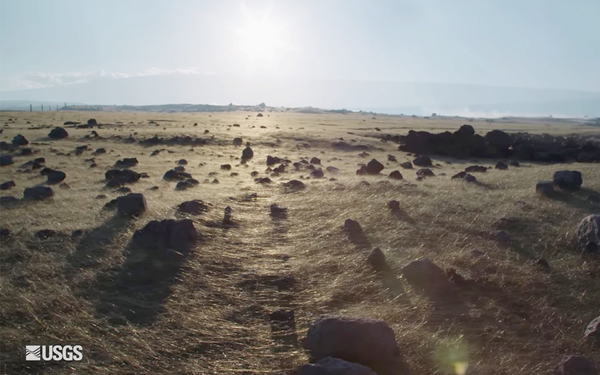
Golden, sharp strands of so-called goddess hair are covering parts of Hawaii's Big Island. But what are these potentially dangerous threads—called Pele's hair—and where did they come from?
The mats of Pele's hair—a product of the ongoing eruption from Kilauea volcano—consist of thin glass fibers that form when gas bubbles within lava burst at the lava's surface, said Don Swanson, a research geologist at the Hawaiian Volcano Observatory.
"The skin of the bursting bubbles flies out, and some of the skin becomes stretched into these very long threads, sometime[s] as long as a couple of feet [0.6 meters] or so," Swanson told Live Science. [Photos: Fiery Lava from Kilauea Volcano Erupts on Hawaii's Big Island]
On supporting science journalism
If you're enjoying this article, consider supporting our award-winning journalism by subscribing. By purchasing a subscription you are helping to ensure the future of impactful stories about the discoveries and ideas shaping our world today.
These gossamer strands are thin, just a micron (one-thousandth of a millimeter) or two in diameter, although some of them are coarser. "Often, they are really like human hair, so the name is very apt," Swanson said.
These strands of lava-turned-glass usually have a small sphere at the end, but this usually gets broken off, Swanson added. Pele's hair—named after Pele (peh-leh), the Hawaiian goddess of fire and volcanoes—is so lightweight that it usually gets blown downwind from where it formed. Because these glass fibers have sharp ends, they can be dangerous to pick up, Swanson noted.
In previous volcanic eruptions, Pele's hair has caused trouble for the many Hawaiians who collect rainwater for drinking water. These glass strands land in rainwater that falls on people's roofs and is then funneled into a catchment system. "If the filters aren't fine enough to filter out the hair, then you can get hair in the water," which can harm anyone who drinks it, Swanson said.
"Imagine inhaling tiny slivers of glass. That's what the Pele's hair is," he said. "It can inflame and irritate anything that comes in contact with it."
Moreover, there are cattle ranches downwind of Kilauea volcano. In the past, Pele's hair floated downwind and fell into the cattle's water troughs, where thirsty bovids slurped it up. This likely injured the cattle's esophagi and stomachs, Swanson said.
However, he hasn't heard any reports of people or cattle hurt by drinking water contaminated with Pele's hair from the current eruption, Swanson said.
Rather, Pele's hair has been more of a nuisance this time around, albeit a rather beautiful one, he said.
"You can get drifts of Pele's hair that may be a foot or two thick interwoven with one another," Swanson said. "It can be quite striking."
Copyright 2018 LiveScience.com, a Purch company. All rights reserved. This material may not be published, broadcast, rewritten or redistributed.