
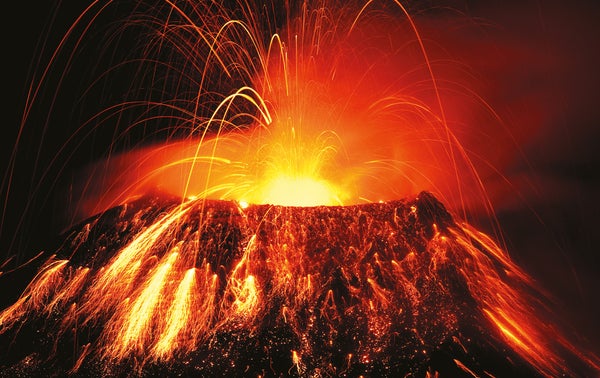
Roughly 450 million years ago a region that was likely the size of Europe started to stretch and tear. Deep gashes opened in Earth's crust, spewing lava that leaped into the air in luminous walls that reached up to 500 meters. Although the ground eventually grew still, the damage had just begun. Once the lava hardened, rainwater dissolved carbon dioxide that the volcanoes had pumped into the atmosphere, washing it back into the ground. Removing the greenhouse gas caused glaciers to creep forward and sea levels to drop, plunging the planet into an ice age that wiped out 85 percent of all marine species.
Researchers laid out this fire-and-ice scenario in a paper recently published in Geology. If confirmed, the findings would offer the first solid clue as to what caused Earth's first mass extinction—hypothesized to be the result of everything from toxic metals unleashed in the oceans to radiation from a distant gamma-ray burst. It also places the so-called Late Ordovician mass extinction in good company: all four other such events have previously been tied to volcanic eruptions.
Lead study author David Jones, a geologist at Amherst College, did not expect this to be the case for the first mass extinction. He initially set out to further disprove the volcanic explanation. But when he “cooked” Late Ordovician rocks from Nevada and southern China in the laboratory, they released large amounts of mercury—a telltale sign that volcanoes had rocked our world.
On supporting science journalism
If you're enjoying this article, consider supporting our award-winning journalism by subscribing. By purchasing a subscription you are helping to ensure the future of impactful stories about the discoveries and ideas shaping our world today.

Credit: Ulet Ifansasti Getty Images
Now the researchers hope to locate a large igneous province—a vast swath of hardened lava—that would date back to the time of the extinction. “It's like if you go to a crime scene and find a dead body with a bullet hole in it. The next step is to look for the gun,” says Seth Burgess, a U.S. Geological Survey geologist, who was not involved in the study. If they find it, he asserts, they will look to see whether “there are gunpowder marks on it.”
Jones has already begun the detective work. Although he and his colleagues suspect the volcanoes sparked a global ice age, Burgess and others think the story is a little more complicated because volcanoes often have the effect of toasting the atmosphere instead of cooling it. Still, with all five mass extinctions linked to volcanic eruptions, geologists can start to tease out the details of each murder mystery.