
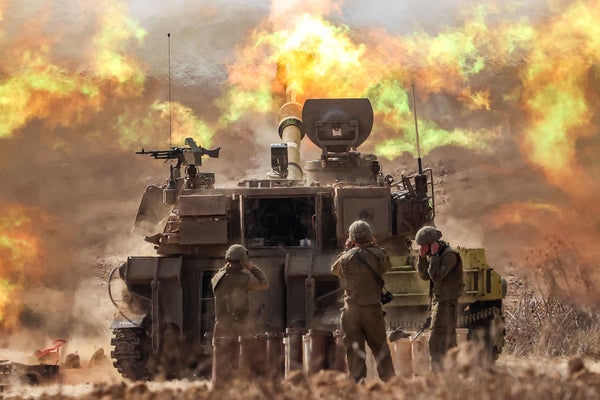
CLIMATEWIRE | One sector of the global economy is conspicuously absent from countries' efforts to halt climate change: the world's militaries.
Nations participating in the Paris climate agreement are not required by the United Nations to report the carbon emissions from their armies and aircraft or warships and weapons. It's up to individual governments to decide whether their armed forces must decarbonize.
But with war a seemingly perpetual feature of the modern age, some experts say it's long overdue that military emissions be counted toward each country's climate targets.
On supporting science journalism
If you're enjoying this article, consider supporting our award-winning journalism by subscribing. By purchasing a subscription you are helping to ensure the future of impactful stories about the discoveries and ideas shaping our world today.
“A lot of what we advocate for is directly to change the reporting framework that the UNFCCC [United Nations Framework Convention on Climate Change] sets out,” said Ellie Kinney, a campaign coordinator with the United Kingdom-based nonprofit the Conflict and Environment Observatory.
“There is absolutely an effort on this at the moment that we’re part of, that lots of other organizations are part of, on recognizing the interconnected nature between war and the climate crisis,” she said Wednesday at a panel on military conflict and climate change hosted for reporters by the global journalism collaboration Covering Climate Now. “And not just war, but militarization overall.”
A group of environmental organizations sent a letter to the U.N. last year urging more stringent and transparent reporting for military emissions. “Our climate emergency can no longer afford to permit the ‘business as usual’ omission of military and conflict-related emissions within the UNFCCC process and international climate negotiations,” they said in the letter, as reported by Reuters.
Scientists and other climate experts have also raised the alarm about the military blind spot in global emissions accounting.
“Military emissions need to be put on the global agenda,” a group of scientists and policy experts stated in a 2022 comment published in the scientific journal Nature. “They must be officially recognized and accurately reported in national inventories, and military operations need to be decarbonized.”
But accounting for global military emissions is a tricky business.
Because the reporting is voluntary, relatively few countries disclose those emissions to the U.N. And estimating them independently is difficult because militaries tend to be secretive, leaving researchers with little data and no standard framework for counting climate pollution. A 2022 report by the Conflict and Environment Observatory suggested that militaries could account for around 5.5 percent of global greenhouse gas emissions — but that could be an underestimate.
Meanwhile, the world is experiencing its highest level of conflict since World War II, according to the U.N.
Recent wars have already had a significant impact on global emissions, preliminary reports have warned.
One recent study, which has not yet been peer-reviewed, suggested that the first 60 days of the war in Gaza spewed more than 281,000 metric tons of carbon dioxide into the atmosphere. It only looked at immediate emissions from sources like aircraft, tanks, rockets and artillery. Long-term reconstruction efforts, meanwhile, could result in tens of millions of metric tons of CO2.
A recent report on Russia’s war in Ukraine suggested that emissions so far, including reconstruction efforts, likely exceeded 150 million metric tons of CO2.
Waging war is just one source of emissions. Preparing for it is another.
U.S. military emissions are the largest of any country worldwide, rivaling the entire annual carbon output of some smaller nations, like Norway or Sweden. They have a wide range of origins, including both military operations and the maintenance of more than 700 U.S. military bases worldwide.
“If you look at us and add up installations and operations, the U.S. is the single-largest [military] energy user, and therefore the U.S. is the largest single institutional emitter,” said Neta Crawford, a political scientist at the University of Oxford, speaking on Wednesday’s panel.
'Business as usual isn’t going to save us'
Controversy over military emissions reporting predates the Paris Agreement. It began with the 1997 Kyoto Protocol, the first international climate treaty focused on reducing global greenhouse gas emissions.
The Kyoto Protocol originally intended to account for military emissions. But the U.S. successfully pushed to exempt them. The U.S. later failed to formally ratify the treaty.
The 2015 Paris Agreement technically removed the exemption for military emissions. But it didn’t require countries to report them, either — making it voluntary instead.
That means few countries choose to make it a priority, said Kinney, the campaigner.
“With things that are voluntary, it doesn't particularly happen, or happen particularly well,” she said.
In the absence of a U.N. requirement, some organizations are working on their own military emissions trackers.
The Military Emissions Gap project is a partnership between the Conflict and Environment Observatory and the U.K. university research consortium Concrete Impacts. It monitors the emissions data that countries voluntarily submitted to the U.N. and attempts to compare those reports with independent estimates of their actual emissions to identify gaps or missing information.
“This is a lot harder than we thought it would be because there’s shockingly little data,” Kinney said.
Part of the problem is that voluntary reports often limit their estimates to only emissions associated with energy use from military bases or fuel use from equipment. They tend to leave out emissions associated with military supply chains and the global weapons industry, which likely account for a large portion of any given nation’s military carbon footprint.
There’s also no standard framework for reporting conflict-related emissions. That makes it difficult for countries to assess the pollution they produce while at war.
The project’s assessments so far indicate that many countries have significant gaps in their reporting, meaning their actual military carbon footprints are likely to be many times higher than the figures they report to the U.N. The U.S. is among them.
U.S. military emissions are declining overall, research suggests — just as U.S. emissions are slowly falling on the whole. That’s largely thanks to economywide shifts from coal to natural gas and other operational and installation changes, said Crawford, the Oxford political scientist.
But deeper changes would require a major rethinking of U.S. military strategy through a climate lens, she added. That means asking big questions about whether certain installations, operations and exercises are still necessary in the modern world.
“I think we need to create an understanding that the way things have gone, business as usual isn’t going to save us,” Crawford said.
Reprinted from E&E News with permission from POLITICO, LLC. Copyright 2024. E&E News provides essential news for energy and environment professionals.