
Global warming isn't just causing glaciers to melt—it's making some collapse suddenly.
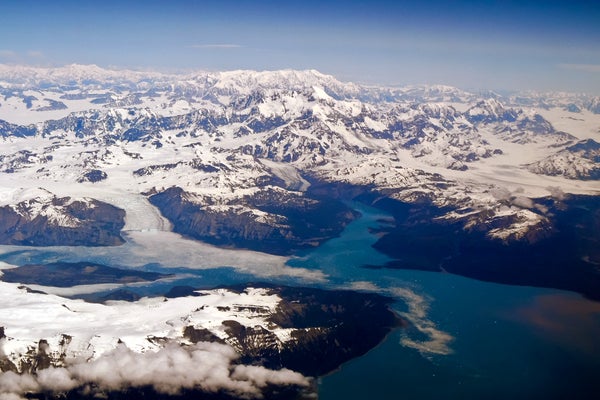
That's what scientists believe happened at Alaska's Flat Creek Glacier, deep in the mountains of Wrangell-St. Elias National Park and Preserve. In August 2013, a 1,600-foot tongue of ice suddenly detached from the bedrock near the bottom of the glacier. It sent a flood of ice and debris hurtling nearly 7 miles down the mountainside.
Then, two years later, the front of the remaining glacier crumbled again. The ice avalanche knocked out hundreds of acres of a 400-year-old forest in its path.
On supporting science journalism
If you're enjoying this article, consider supporting our award-winning journalism by subscribing. By purchasing a subscription you are helping to ensure the future of impactful stories about the discoveries and ideas shaping our world today.
At the time, scientists were unsure what triggered these sudden events. But a recent study offers some new insight.
An unusually warm summer melted large volumes of ice in 2013. The meltwater pooled behind the cold tongue of ice at the front of the glacier, exerting more and more pressure as it built up.
Finally, the pressure became too much. The tongue broke away from the rock below, and the ice went cascading down the mountain.
The summer of 2015 was also warmer than average, although not so warm as 2013. But in its weakened state, the glacier was primed to crumble again.
The researchers, led by Mylène Jacquemart of the University of Colorado, used aerial photos and satellite images of the landscape, along with local climate data, to investigate the glacier's collapse. They conclude that the high temperatures of 2013 were the likely culprit.
That means these kinds of events could become a bigger threat as temperatures rise around the globe.
"If you stand in front of any glacier in the world, the chance that it comes crashing down on you is incredibly low," Jacquemart said. "But if we look at all the glaciers globally, I do think it is likely that we will see these things probably more frequently."
Warning signs
Anecdotally, reports of collapsing mountain glaciers do seem to be on the uptick in recent years, Jacquemart noted. For now, it's hard to say whether that's due to global warming or whether scientists are just getting better at observing the Earth's remote places with satellite data. It may be some of both.
In any case, Flat Creek Glacier isn't the only one that's recently crumbled.
In 2002, the sudden collapse of the Kolka Glacier in Russia triggered a devastating avalanche that hurtled more than 15 miles down the mountainside and killed dozens of people.
Two separate glaciers in Tibet's Aru mountain range catastrophically collapsed in 2016, the first killing nine people and hundreds of livestock animals as it swept down the mountain. Both events were documented in a 2018 paper in Nature Geoscience.
Earlier this year, a similar event was reported in Salkantay, Peru, near Machu Picchu.
Not all these events have been clearly explained. But at least a couple seem to share similar characteristics with Flat Creek Glacier.
The two Aru glaciers were structured much like Flat Creek, Jacquemart and colleagues suggest. It's likely that meltwater had been accumulating behind the ice for several years before the glaciers gave way.
The 2018 paper describing the two events suggested that heavy precipitation, occurring shortly before the glaciers' collapse, may have helped trigger one or both of the disasters.
On the other hand, Russia's Kolka Glacier was structurally much different. The climate there was already more temperate to begin with, and the collapse was probably triggered by pressure from a buildup of fallen debris.
In general, according to Jacquemart, there are some characteristics that may make a glacier more susceptible to the influence of warming. These include smaller glaciers with thin, cold tongues of ice frozen to the bedrock. Glaciers sitting on crumbly sediment, or a landscape rich in soft clay, may also be more vulnerable.
Scientists estimate there are about 200,000 glaciers around the world, and monitoring all of them is a hefty task. Still, improved satellite data is making it easier for researchers to keep an eye on how the world's frozen places are changing.
Just prior to the second Aru glacier collapse, for instance, satellite data indicated a network of cracks spreading through the ice. Scientists noticed the warning signs and issued an alert to the Chinese government.
At the same time, scientists are also working to better understand how often these kinds of events occurred in the past. Part of that work involves looking for clues in mountain landscapes—signs that a glacier has collapsed there before.
This will help scientists figure out whether mountain glaciers really are collapsing more frequently today—or whether it just seems that way because it's getting easier to detect these events.
"I think it's likely that these things have happened in the past," Jacquemart said. "But the fact that we are seeing so many at this point I think cannot be explained only with better observations."
Reprinted from Climatewire with permission from E&E News. E&E provides daily coverage of essential energy and environmental news at www.eenews.net.