
In the race to adapt to a rapidly changing climate, warm-blooded animals might have the edge.
New research suggests that over millions of years of planetary history, birds and mammals have outperformed amphibians and reptiles at adapting to changing temperatures and shifting their habitats to more suitable locations.
The study published yesterday in Nature Ecology and Evolution analyzed data on more than 11,000 vertebrate species, including fossil records from the past 270 million years. Comparing these records with ancient temperature reconstructions, the researchers found that warm-blooded animals had much greater success at expanding their ranges and adapting to new climate conditions. These shifts tended to occur much more slowly in cold-blooded animals.
On supporting science journalism
If you're enjoying this article, consider supporting our award-winning journalism by subscribing. By purchasing a subscription you are helping to ensure the future of impactful stories about the discoveries and ideas shaping our world today.
"We see that mammals and birds are better able to stretch out and extend their habitats, meaning they adapt and shift much easier," lead study author Jonathan Rolland, a postdoctoral research fellow at Canada's University of British Columbia, said in a statement. "This could have a deep impact on extinction rates and what our world looks like in the future."
There are several reasons warm-blooded animals may have historically one-upped their scaly cousins. Because birds and mammals regulate their own body temperatures, they don't have to adjust their behavior according to the outside temperature as dramatically as cold-blooded animals. Amphibians and reptiles, for instance, must often significantly scale back their activity levels in cooler weather, which puts them at a disadvantage when it comes to finding food, mates or new habitats, according to the research.
Warm-blooded animals are also able to use their own bodies to keep their developing babies warm, while cold-blooded animals must stay within suitable climate conditions for their eggs to develop and hatch.
In the past, these traits have been particularly useful at helping birds and mammals disperse around the world during periods of global cooling, the researchers point out, including a major cooling episode that occurred around 34 million years ago. But some scientists believe that the current period of rapid global warming may disproportionately affect cold-blooded animals, as well.
Barry Sinervo, a reptile and ecology expert at the University of California, Santa Cruz, who was not involved with the recent study, pointed to some of his own research, such as a study published in Science in May 2010 that examined extinction rates in lizards alongside changing climatic conditions.
The study projected that as many as 20 percent of lizard species worldwide could go extinct by 2080, and local extinctions—the disappearance of a population in one particular geographic location—could reach as high as 40 percent. The study also suggested that about 4 percent of local populations have already gone extinct since 1975.
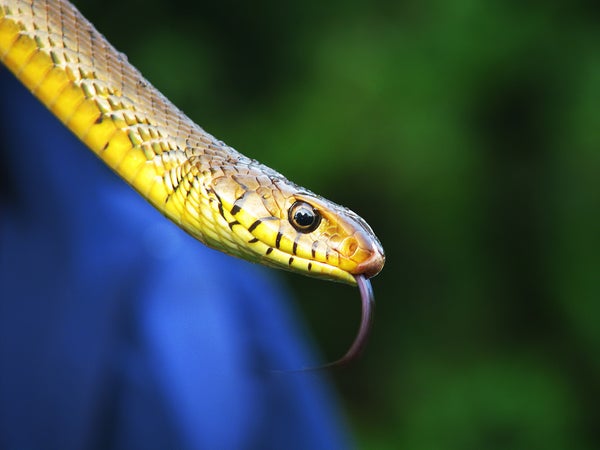
While it's easy to think that snakes and lizards might be happy to bask in warmer weather, reptiles—like any other animals—have their temperature limits. As global temperatures continue to climb, some areas may grow too hot for their cold-blooded inhabitants. And the new study suggests that, historically speaking, these animals are slower at expanding into more suitable habitats.
"I would have to agree with the authors, that ectotherms are at much higher risk than endotherms," Sinervo said.
Reprinted from Climatewire with permission from E&E News. E&E provides daily coverage of essential energy and environmental news at www.eenews.net.