
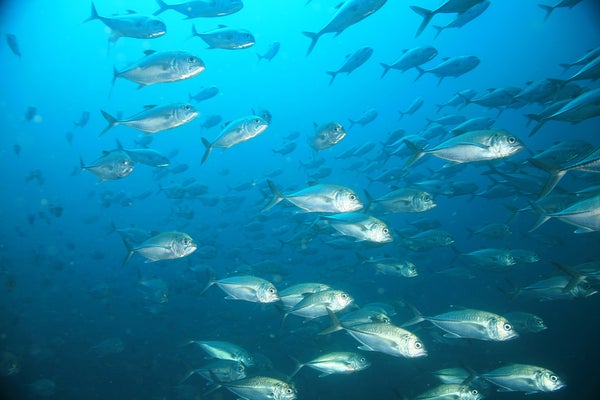
Fish will struggle to breathe as the ocean waters warm, researchers say, and bigger fish will have bigger problems.
That means important species could soon top out well short of their current sizes—shrinking fisheries and potentially causing problems up the food chain.
Fish have proved sensitive to subtle changes, and higher temperatures could present them with two problems—a change in the water and a change in their biology.
On supporting science journalism
If you're enjoying this article, consider supporting our award-winning journalism by subscribing. By purchasing a subscription you are helping to ensure the future of impactful stories about the discoveries and ideas shaping our world today.
First, warmer water holds less oxygen. Past studies suggest the last half-century of warming has already sapped oceans’ oxygen levels by 2 percent (Greenwire, Feb. 17).
Second, fish are cold-blooded. Warmer waters crank up their metabolism—meaning their bodies need more oxygen precisely when the water holds less of it.
“The two [effects] exacerbate each other big time—big time. This is a major problem,” said Daniel Pauly, a principal investigator with the University of British Columbia’s Sea Around Us research initiative.
In a study published this week in the journal Global Change Biology, Pauly and William Cheung, director of science at the University of British Columbia’s Nippon Foundation-Nereus Program, quantify how much the metabolic changes could stunt fish growth.
Some fish already shrinking
On average, 1 degree Celsius of ocean warming could cause fish to grow as much as 30 percent smaller; a change of 2 degrees C could make them 45 percent smaller. Big, active fish like tuna could see even greater effects, according to the study.
Fish already operate on a tight oxygen budget under normal conditions. That’s because their bodies grow faster than their gills. They stop growing once their gills reach the limit of how much oxygen they can supply the body, Pauly said.
If that limit stretches further, either by the body demanding more oxygen or the gills supplying less, the fish’s response will be to stop growing sooner, Pauly said. Small fish already have a higher gill-to-body ratio, so they’ll likely see less changes.
Researchers in the North Sea have already documented shrinking fish sizes that cannot be traced back to commercial fishing or other factors, Cheung said.
Some scientists have suggested fish could adapt by expanding their gill system. But there are hard limits to that, Pauly said.
It’s a problem of dimensions, he said. There’s only so much space on a fish’s surface. And water that washes over a gill has already given up its oxygen, so growing deeper gills doesn’t help.
Reprinted from Climatewire with permission from E&E News. E&E provides daily coverage of essential energy and environmental news at www.eenews.net.