
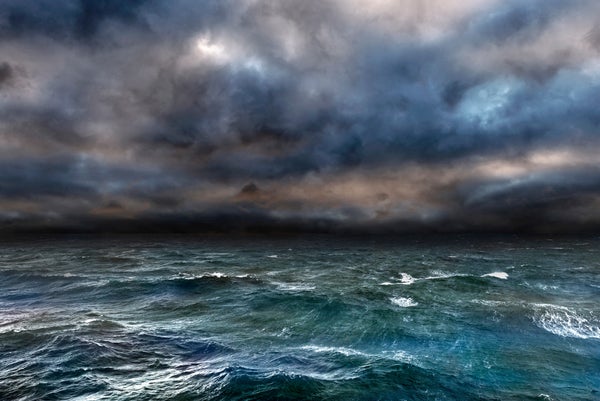
Summer and fall 2017 saw an unusual string of record-breaking hurricanes pummel the U.S. Gulf Coast, eastern seaboard, Puerto Rico and the Caribbean.
Hurricane Harvey brought unbelievable floods to Houston. Irma, one of the two strongest hurricanes ever recorded in the northern Atlantic, wreaked havoc on Florida and many Caribbean islands. Maria devastated Puerto Rico and the Virgin Islands. The destruction begs the question: Has climate change influenced these extreme events? Hurricanes can be difficult to decipher, but experts are gaining a sense of what our warming world might mean for monster storms in the U.S. and worldwide.
Storm Intensity
On supporting science journalism
If you're enjoying this article, consider supporting our award-winning journalism by subscribing. By purchasing a subscription you are helping to ensure the future of impactful stories about the discoveries and ideas shaping our world today.
Many experts are confident that a warmer world will create stronger storms—and already is doing so. Since 1981 the maximum wind speed of the most powerful hurricanes has risen, according to research (pdf) by Jim Elsner, a climatologist at The Florida State University. That’s because higher ocean heat provides more energy for storms, fueling their intensity. Hurricane Patricia, in 2015, set the record at the time for top wind speed—215 miles per hour—in the north Atlantic. The next year Winston shattered records as the most intense cyclone in the Southern Hemisphere.
The dynamic between storms and warming oceans occurs in part because of the role hurricanes play in our climate system: they rebalance Earth’s heat. The storms remove heat from tropical oceans in the form of moisture and pump the heat up into the atmosphere, where heat is redistributed and radiated out into space. “In some sense, hurricanes are a relief valve,” explains Kevin Trenberth, a senior scientist in the Climate Analysis Section at the National Center for Atmospheric Research. “From the climate standpoint, you need to have some hurricanes to come along and cool the ocean, to keep them at reasonable temperatures. No other phenomenon can play this role.”
Frequency
How climate change will influence the frequency of hurricanes is less well understood. Some experts predict a potential drop in overall numbers. In rebalancing Earth’s heat, Trenberth says, “one big hurricane can play the role of four smaller hurricanes.” Tom Knutson, a climate scientist at the National Oceanic and Atmospheric Administration’s Geophysical Fluid Dynamics Laboratory, says nearly all models predict this effect—theyshow a decrease in the total number of hurricanes in a warmer climate. Elsner notes, however, “There’s still a lot of uncertainty on this point.”
Both Trenberth and Knutson think the number of very intense storms may actually grow. Some studies show that globally, “we end up with more storms at the high end—at category 4 and 5,” Trenberth says. The north Atlantic, in particular, may experience this trend.Elsner is more hesitant; he says the frequency of the strongest hurricanes is also controlled by the occurrence of ideal conditions—no wind shear high in the atmosphere to tear storms apart from above, no land in their path to break them up from below and no dry air to absorb some of their moisture. “It is unknown how or if these conditions will change,” he says.
Size and Duration
Scientists are still unsure about how climate change will influence the physical breadth and duration of hurricanes. In their modeling Knutson and his team have found that the number of category 4 and 5 storm days could potentially increase slightly by the late 21st century. Trenberth thinks higher ocean temperatures may mean storms will become both bigger in size and last longer. He does note, though, that these traits depend on how storm details are defined: For a storm’s breadth across the ocean, for example, where are the boundaries drawn? Does “duration” apply to its time as a specific hurricane category (4, 5) or as an overall tropical storm?
Storm Surge
Scientists do agree climate change means higher storm surges are hitting coastlines. This would happen even if hurricanes do not become stronger. “Once you have a higher baseline sea level,” Knutson says, “that's going to add to the water level experienced during storm surges.” If sea level is a half-meter higher, for example, then a storm surge will be a half-meter higher than it would have been otherwise.
Rainfall
Experts also expect that climate change may increase the intensity of hurricane rainfall. The unprecedented, deep flooding in the Houston area certainly bears witness to that idea. Warmer air holds more water vapor. For hurricanes, “that can lead to more efficiency; the rate at which rain falls out of the clouds increases,” Elsner says. “We’re seeing that in some of these storms.” Knutson gives a number for this phenomenon: Hurricane rainfall rate is projected to rise 7 percent for every degree Celsius rise in tropical sea surface temperatures.
Expanding Reach
Regions of the world that have not experienced hurricanes may in the future. As oceans heat up, the cyclonic storms’ territory could enlarge. “If a storm remains over warm water, it can maintain a high intensity,” Elsner says. “If those warm waters are expanding, then you can find these strong storms in [new] places.” Trenberth agrees: “Witness Ophelia,” which surprised Ireland and the U.K. in October.
Even though scientists are investigating these potentially changing factors, they caution that uncertainty remains for many of them. Hurricanes are particularly challenging because they are such complex and relatively rare events. “Not only is there large variability but the reliable record is short—satellite [tracking] began about 1970,” Trenberth says. Plus, many other forces (pdf)—such as weak wind shear and low pressure at the sea surface—influence this type of storm.
Knutson is less certain than others that it is possible to already see global warming’s influence on any of these factors in the record (except for higher storm surge due to sea level rise). It is too early “to say that we can detect this change already in the data, and it’s clearly distinct from natural variability,” Knutson says. “That limits our confidence in future projections.”
But Elsner says the growing intensity of hurricanes is already evident in the record. “It has already been shown that the strongest hurricanes are getting stronger worldwide,” Elsner wrote in an e-mail to Scientific American. Trenberth goes further. “The environment in which all such storms occur is warmer and moister, and we know that this has effects,” he notes. “The evidence is that climate change is already with us.”