
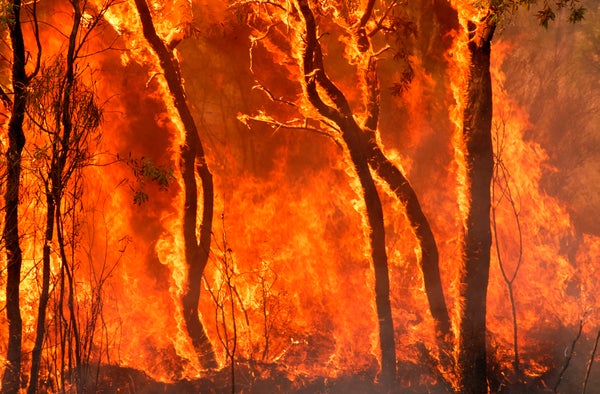
Watching a wildfire from within—seeing the flames fly above, below, and for 360 degrees all around—can offer scientists and firefighters valuable information about how these increasingly threatening blazes behave and spread. But the average forest fire sends temperatures rocketing up past 800 degrees Celsius (1,472 degrees Fahrenheit), hot enough to cremate a human or melt a camera. So, researchers at the National Institute of Standards and Technology (NIST) recently surrounded their equipment with a coolant that also happens to filter damaging infrared light: water. This let them capture completely surrounding footage of fires like the controlled burn in the video featured here, in the New Jersey Pine Barrens. Viewers can simply click the screen and drag the cursor to shift their viewpoint.
In the NIST setup, a waterproof camera sits in a liquid-filled bulb made of heat-resistant glass. “It’s exactly like a snow globe with a camera in the middle,” says the system’s developer, Matthew Hoehler, a research structural engineer at NIST’s National Fire Research Laboratory. Pipes connect the glass to a buried water tank that acts as a heat sink: As the flames heat the liquid, it is pumped out of the bulb and replaced with cool water from the tank. This not only prevents the camera from overheating; it also filters out thermal radiation. “Even if you could cool the camera in some way with air or liquid nitrogen, you still have this infrared radiation from a fire, which is very intense and is problematic for laser optics and camera sensors,” Hoehler says. Water blocks wavelengths in the infrared range while allowing visible light to pass through.
On supporting science journalism
If you're enjoying this article, consider supporting our award-winning journalism by subscribing. By purchasing a subscription you are helping to ensure the future of impactful stories about the discoveries and ideas shaping our world today.
Because it takes time to set up this system, Hoehler can only use it when he knows he has two to three hours before a fire reaches his site. For example, because the blaze at the New Jersey Pine Barrens was a “prescribed burn” (deliberately set to help with forest management), the fire service was able to tip off NIST team members well before the fire started. This gave the researchers plenty of time to set up their equipment and bury the water tank. In the future, Hoehler hopes to develop an aboveground version that would only take 20 to 30 minutes to deploy, allowing him to film actual wildfires.
Although researchers already observe ongoing fires with drones in the air and measuring devices on the ground, they had not shot 360-degree videos like this before. “This is really the first thing that’s able to capture the photos and the real-time video imagery in the way that it does with the three-dimensional perspective,” says Robin Verble, associate professor of biological sciences and director of the Ozark Research Field Station at Missouri University of Science and Technology, who was not involved with the NIST research. “Being able to see inside and get an interior perspective will be immensely useful.” For example, she suggests that this view will help researchers study a fire’s inner “weather” and test existing models of fire severity.
The videos could also serve as educational tools for the public. Verble points out that they can teach people how fire spreads. “The general public has a lot of lot of misconceptions,” she says, “so anything that can engage a general audience would be really beneficial.” To make them even more informative, Hoehler wants to augment the videos by layering data about temperature and air flow on top of the visuals. “The videos are neat, and I think they’re compelling for people,” he says. “But it’s also a more modern way of communicating data from complex experiments.”