
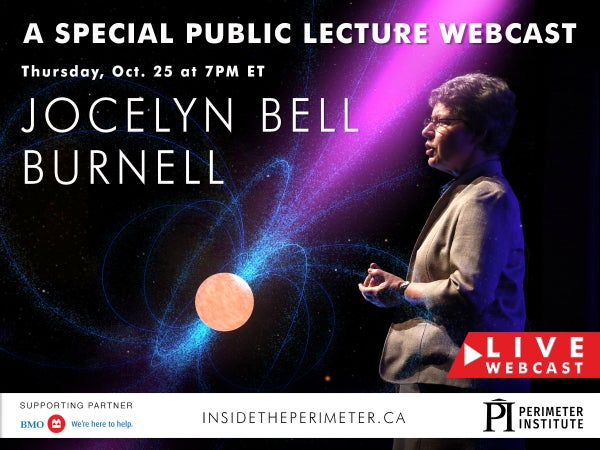
Jocelyn Bell Burnell, winner of the 2018 Special Breakthrough Prize in Fundamental Physics, is an accomplished scientist and champion for women in physics. As a graduate student in 1967, she co-discovered pulsars, a breakthrough widely considered one of the most important scientific advances of the 20th century. When the discovery of pulsars was recognized with the 1974 Nobel Prize in Physics, the award went to her graduate advisor. Undaunted, she persevered and became one of the most prominent researchers in her field and an advocate for women and other underrepresented groups in physics.
She plans to use the $3 million Breakthrough Prize to fund women and other underrepresented groups pursuing physics to bring greater diversity to the field.
During her distinguished career she has been president of both the Institute of Physics and the Royal Astronomical Society, and she is currently a visiting professor of astrophysics at the University of Oxford and chancellor of Scotland’s University of Dundee.
On supporting science journalism
If you're enjoying this article, consider supporting our award-winning journalism by subscribing. By purchasing a subscription you are helping to ensure the future of impactful stories about the discoveries and ideas shaping our world today.
In a special public lecture at the Perimeter Institute on Thursday, October 25 at 7 P.M. Eastern time, Dame Bell Burnell will take audiences on a journey into the realm of pulsars and share stories from her personal journey of scientific discovery. Online viewers can participate in the discussion by tweeting to @Perimeter using the #piLIVE hashtag. The title of her talk evokes the moment she noticed something peculiar in experimental data, and how that peculiar find launched her career: “’What is that?!’ The Discovery of Pulsars: A Grad Student’s Story.”