
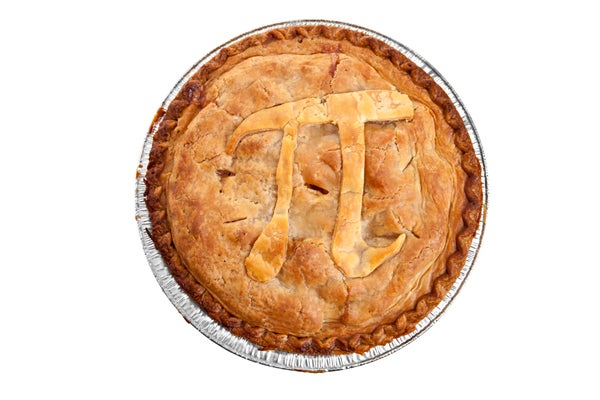
Eugenia Cheng’s passion for theoretical mathematics is rivaled only by her love of food. In talks and in her book, How to Bake Pi: An Edible Exploration of the Mathematics of Mathematics, the mathematician and pianist uses baking and cooking to explore the concepts behind pure math.
Pure mathematics deals with its underlying structures and concepts. It is sometimes referred to as math for math’s sake and has a philosophical bent, in contrast to the more familiar applied mathematics used for problem-solving. Cheng, currently a scientist in residence at the School of the Art Institute of Chicago, specializes in a particularly abstract area of pure mathematics known as category theory, or what she calls “the mathematics of mathematics,” which looks at structures and systems of structures.
On supporting science journalism
If you're enjoying this article, consider supporting our award-winning journalism by subscribing. By purchasing a subscription you are helping to ensure the future of impactful stories about the discoveries and ideas shaping our world today.
Her book includes recipes but Cheng uses rules and rule-breaking in baking and cooking as well as the experience of serving and even eating foods to explain her own study of math. She opens the prologue with an analogy: Just as a rice cooker can also make clotted cream, math is about numbers but also serves other purposes. She uses cookies to illustrate the importance of abstraction. How many cookies you have at a given moment depends on how much you felt like eating some of those cookies just now. But if you turn them into abstract things, such as numbers, you can add and subtract them without worrying about whether you might eat them. (Numbers obey logic in a way food will not.) She shares an anecdote about successfully improvising a recipe for chocolate cake because she was so familiar with the rules of ratios in baking. “The point is that if you understand the principle behind a process rather than just memorizing the process, you will be much more in control of the situation,” she wrote. In one YouTube talk given while she was a professor at the University of Sheffield, Cheng even explores the ideal ratio of jam and cream to scone size, using an array of scones she has baked in 25 different sizes.
Cheng will share a lesson in food and pure mathematics from the Perimeter Institute on Wednesday, April 5 at 7 P.M. Eastern time. The talk will be broadcast live on this page as well as on the Perimeter Web site. Online viewers can ask questions before and during the event by tweeting to @Perimeter using the #piLIVE hashtag or commenting on the institute’s Facebook posts about the event.