
Particle physicists typically aren’t looking for a cure to an illness or a solution to an underlying societal problem. Propelled by curiosity, they are searching for answers about what makes up, well, everything. And they have a long way to go—roughly 95 percent of the universe seems to consist of dark matter and dark energy, about which we know next to nothing. So what is the nature of that mysterious dark stuff? Why is there so much of it? And why is there so relatively little of what we are familiar with—galaxies, stars, planets? Why, in fact, is there something rather than nothing at all?
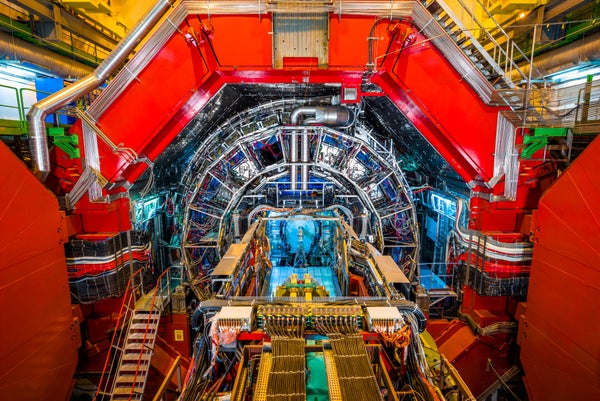
In particle physics the preferred way to tackle these fundamental questions is to gather thousands of scientists from dozens of nations to build a big, expensive machine. The biggest and most expensive at present is CERN’s Large Hadron Collider (LHC), a 27-kilometer-long subterranean tunnel lined with superconducting magnets that smashes particles together at nearly light-speed in search of even smaller and more elusive particles in the subatomic wreckage. The feat seems improbable, even silly—like searching for the meaning of an abstract painting or of a figure in the clouds. Yet, five years ago LHC physicists demonstrated the collider’s potential by discovering the Higgs boson, the long-sought particle that imbues all other particles with mass. By virtue of its weighty task, the Higgs helps explain why we exist and why we look out on a sky filled with stars—without its handiwork, the universe would be bereft of such forms, existing instead as an amorphous soup of zooming particles. It was one of the greatest discoveries of all time in particle physics, leaving scientists beaming and the world in wonderment. Yet, such research is sometimes described as “useless” for not having an immediate practical application to everyday life. Does it deserve this harsh assessment?
Pauline Gagnon, a retired particle physicist from Indiana University Bloomington and CERN argues that even beyond the understanding it gives us of our own universe, such fundamental research leads to many spin-off technological developments, from the World Wide Web (originated at CERN) to medical imaging.
On supporting science journalism
If you're enjoying this article, consider supporting our award-winning journalism by subscribing. By purchasing a subscription you are helping to ensure the future of impactful stories about the discoveries and ideas shaping our world today.
Join Gagnon tonight at the Perimeter Institute for Theoretical Physics in Ontario for a glimpse into how fundamental research can, in fact, be vital for advancing technology and improving lives. The talk, “Improbable Feats and Useless Discoveries” is part of Perimeter’s public lecture series and will take place at 7 P.M. Eastern time. Online viewers can participate in the discussion by tweeting to @perimeter using the #piLIVE hashtag.