
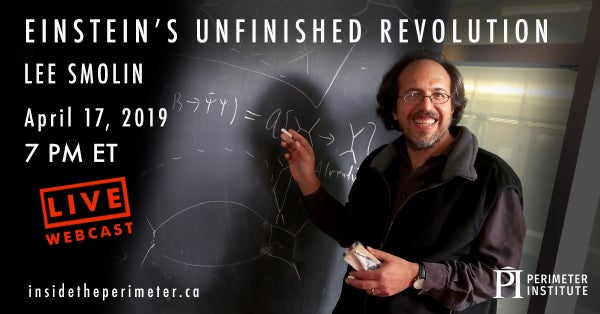
Lee Smolin, author of six books about the philosophical issues raised by contemporary physics, says every time he writes a new one, the experience completely changes the direction his own research is taking. In his latest book, Einstein’s Unfinished Revolution: The Search for What Lies Beyond the Quantum, Smolin, a cosmologist and quantum theorist at the Perimeter Institute for Theoretical Physics in Ontario, tackles what he sees as the limitations in quantum theory.
“I want to say the scientific worldview is based on fallacious reasoning at certain key points,” Smolin says. In Einstein’s Unfinished Revolution, he argues one of those key points was the assumption that quantum physics is a complete theory. This incompleteness, Smolin argues, is the reason quantum physics has not been able to solve certain questions about the universe.
On supporting science journalism
If you're enjoying this article, consider supporting our award-winning journalism by subscribing. By purchasing a subscription you are helping to ensure the future of impactful stories about the discoveries and ideas shaping our world today.
“Most of what we do [in science] is take the laws that have been discovered by experiments to apply to parts of the universe, and just assume that they can be scaled up to apply to the whole universe,” Smolin says. “I’m going to be suggesting that’s wrong.”
Join Smolin at the Perimeter Institute as he discusses his book and takes the audience on a journey through the basics of quantum physics and the experiments and scientists who have changed our understanding of the universe. The discussion, “Einstein’s Unfinished Revolution,” is part of Perimeter’s public lecture series and will take place on Wednesday, April 17, at 7 P.M. Eastern time. Online viewers can participate in the discussion by tweeting to @Perimeter using the #piLIVE hashtag.