
Massive objects bend and warp spacetime, a phenomenon Albert Einstein asserted in his general theory of relativity. When two such objects—such as black holes or neutron stars—merge, the collision generates subtle spacetime ripples called gravitational waves. Although his theory predicted them, Einstein remained skeptical that gravitational waves actually existed or could ever be observed. Now, however, they are routinely detected by extremely sensitive instruments, such as the Laser Interferometer Gravitational-Wave Observatory (LIGO), a continent-spanning experiment with “listening” stations in Hanford, Wash., and Livingston, La.
Chad Hanna, an astrophysicist at Pennsylvania State University, studies gravitational waves with LIGO, detecting them in close to real time as they wash over our planet from merging neutron stars and black holes billions of light-years away.
On supporting science journalism
If you're enjoying this article, consider supporting our award-winning journalism by subscribing. By purchasing a subscription you are helping to ensure the future of impactful stories about the discoveries and ideas shaping our world today.
“If we were to look back at astronomy getting its start with people literally looking up at the night sky, compared to the sort of things that we know now by, for example, looking at the Hubble telescope images, the difference is vast,” Hanna says. “I expect gravitational-wave astronomy to provide the same sort of insight into our universe in the coming years. It should open up new discoveries that we can’t even imagine.”
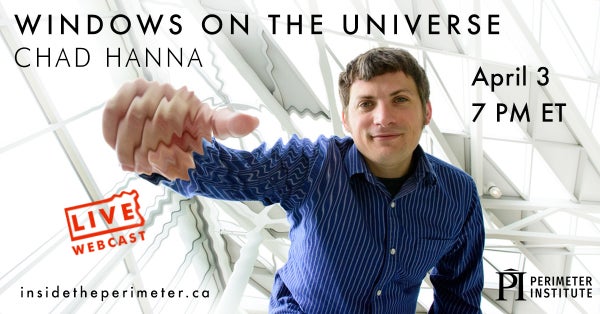
Join Hanna at the Perimeter Institute for Theoretical Physics in Ontario as he describes how gravitational-wave astronomy has changed our understanding of the universe and what LIGO could reveal in the near future. The discussion, “Windows on the Universe,” is part of Perimeter’s public lecture series and will take place on Wednesday, April 3, at 7 P.M. Eastern time. Online viewers can participate in the discussion by tweeting to @Perimeter using the #piLIVE hashtag.