
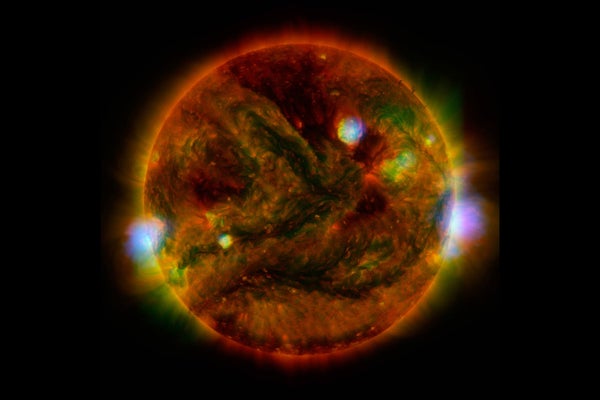

There are billions of trillions of stars spattered across a vast universe, most of which we will never be able to see. Of the ones we can, many are long dead, their light only now reaching us after traveling for eons through space. These ancient twinkles allow us to glimpse the universe as it looked billions of years ago, helping us read the timeline of its evolution.
The most familiar star to us, our main-sequence yellow dwarf sun, naturally seems “typical” to us whereas others might seem more alien. Some stars are blue or white or red—although never green or violet, for reasons both optical and astrophysical. Some burn out in massive detonations visible clear across the cosmos; others fade away, thought to leave behind planet-size carbon corpses crystallized into diamond. Many stars—perhaps most, it turns out—are in one respect or another rather weird.
Neutron stars, for example, are some of the smallest and densest stars in the universe. They form when massive stars explode in supernovae, each leaving behind a core that collapses in on itself and squeezes electrons and protons together into neutrons. Sometimes neutron stars are so dense they collapse into black holes. And one hypothesis suggests that if they are not dense enough, they may turn into “strange stars,” made of even smaller subatomic particles called quarks. Some other ideas posit that if a supergiant (an incredibly large star that is about to die) swallows a neutron star, it could form what is theorized as a Thorne–Zytkow object—a star within a star. These oddities—and undoubtedly many others theorists have yet to even dream of—fill out our universe’s bizarre stellar bestiary.
On supporting science journalism
If you're enjoying this article, consider supporting our award-winning journalism by subscribing. By purchasing a subscription you are helping to ensure the future of impactful stories about the discoveries and ideas shaping our world today.
Emily Levesque is an assistant professor of astronomy at the University of Washington, and is interested in exploring these oddities to learn more about the history and current state of our universe. Here, you can tune in to Levesque at the Perimeter Institute for Theoretical Physics in Ontario for a glimpse into the strange stars of the universe, the history of discoveries and the current techniques astronomers employ. Her talk, “The Weirdest Stars in the Universe,” is the latest installment of Perimeter’s public lecture series.