Watch SpaceX Launch Historic Fram2 Crewed Mission over Earth’s Poles Tonight

Fram2, a first-of-its-kind private mission to send four astronauts into polar orbit around Earth, is about to launch

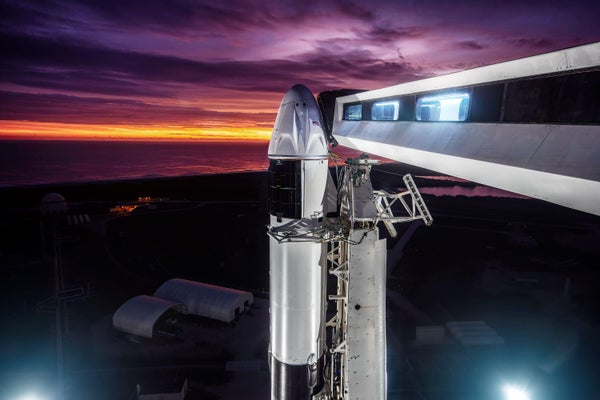
SpaceX Falcon 9 rocket vertical with the Crew Dragon atop.

A close-up view of a SpaceX Falcon 9 rocket and a Crew Dragon spacecraft before a launch at NASA’s Kennedy Space Center in Florida. The four-person Fram2 crew is set to ride similar hardware into polar orbit on the evening of March 31, 2025.

Evgeniy Baranov/Alamy Stock Photo

Join Our Community of Science Lovers!

SpaceX plans to launch the Fram2 astronaut mission over Earth's poles tonight (March 31), and you can watch the action live.

Fram2's Falcon 9 rocket and Crew Dragon capsule are scheduled to lift off from Launch Complex 39A at NASA's Kennedy Space Center in Florida tonight at 9:46 p.m. ET (0146 GMT on April 1). If that timeline isn't met, there are three additional opportunities available over the next roughly 4.5 hours, at 11:20 p.m. ET (0320 GMT), 12:53 a.m. ET (0453 GMT) and 2:26 a.m ET (0626 GMT).

SpaceX will stream the launch live via its website and X account, beginning about an hour before liftoff. Space.com will air the webcast as well.


On supporting science journalism

If you're enjoying this article, consider supporting our award-winning journalism by subscribing. By purchasing a subscription you are helping to ensure the future of impactful stories about the discoveries and ideas shaping our world today.


Fram2 will send four people from four different nations to low Earth orbit for three to five days. Those crewmembers — all of them spaceflight rookies — are mission commander Chun Wang of Malta, vehicle commander Jannicke Mikkelsen of Norway, pilot Rabea Rogge of Germany, and Australian Eric Phillips, Fram2's medical officer and mission specialist.

The quartet will circle our planet over both of its poles — a trajectory no human spaceflight mission has ever taken before. Fram2 will also break ground with several of its 22 science experiments. For example, the mission will attempt to grow mushrooms and take X-rays of the human body in orbit for the first time.

"Additionally, after safely returning to Earth, the crew plans to exit from the Dragon spacecraft without additional medical and operational assistance, helping researchers characterize the ability of astronauts to perform unassisted functional tasks after short and long durations in space," SpaceX wrote in a Fram2 mission description.

Fram2 will be SpaceX's 17th human spaceflight overall and the sixth conducted for private customers. Among the company's other commercial human flights were Inspiration4 and Polaris Dawn, both of which were funded and commanded by Jared Isaacman, President Donald Trump's nominee to be the next NASA chief.

SpaceX's 11 other crewed missions to date have been voyages to and from the International Space Station for NASA.

Copyright 2025 Space.com, a Future company. All rights reserved. This material may not be published, broadcast, rewritten or redistributed.

Mike Wall has been writing for Space.com since 2010. His book about the search for alien life, “Out There,” was published on Nov. 13, 2018. Before becoming a science writer, Michael worked as a herpetologist and wildlife biologist. He has a Ph.D. in evolutionary biology from the University of Sydney, Australia, a bachelor’s degree from the University of Arizona, and a graduate certificate in science writing from the University of California, Santa Cruz.

More by Mike Wall

SPACE.com is the premier source of space exploration, innovation and astronomy news, chronicling (and celebrating) humanity's ongoing expansion across the final frontier.

More by SPACE.com

It’s Time to Stand Up for Science

If you enjoyed this article, I’d like to ask for your support. Scientific American has served as an advocate for science and industry for 180 years, and right now may be the most critical moment in that two-century history.

I’ve been a Scientific American subscriber since I was 12 years old, and it helped shape the way I look at the world. SciAm always educates and delights me, and inspires a sense of awe for our vast, beautiful universe. I hope it does that for you, too.

If you subscribe to Scientific American, you help ensure that our coverage is centered on meaningful research and discovery; that we have the resources to report on the decisions that threaten labs across the U.S.; and that we support both budding and working scientists at a time when the value of science itself too often goes unrecognized.

In return, you get essential news, captivating podcasts, brilliant infographics, can't-miss newsletters, must-watch videos, challenging games, and the science world's best writing and reporting. You can even gift someone a subscription.

There has never been a more important time for us to stand up and show why science matters. I hope you’ll support us in that mission.

Thank you,

David M. Ewalt, Editor in Chief, Scientific American

Subscribe