
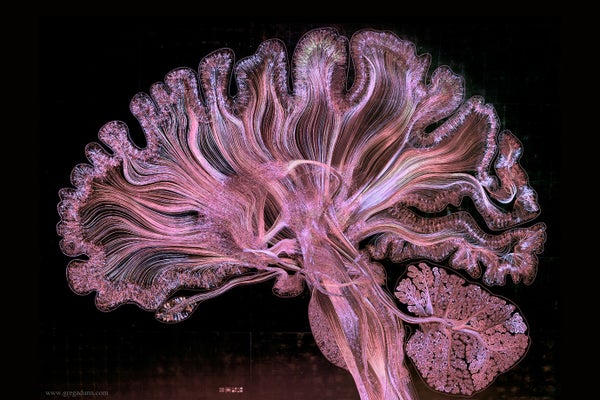
Sometimes neuroscientist Greg Dunn finds his field tedious. Working at a lab bench can make you forget how beautifully ornate the human brain is, he says. To reinspire himself, his colleagues and the public, Dunn makes art. Most recently he made an eight- by 11-foot gilded engraving of the human brain.
Titled “Self Reflected,” the piece maps Dunn’s illustrations of neurons and axons via algorithmically guided microetchings. As LEDs scan across the surface, they reflect off the varying depths and angles of the gold leaf grooves to make each neurological pathway shimmer like it is truly alive with electrical firings. The art is on display at The Franklin Institute in Philadelphia but videos like the one below are also on the project’s Web site. Watching the massive display composed of minute and intricate carvings is overwhelming—and that’s kind of the point, says Dunn, who received his neuroscience doctorate in 2011 but has dedicated his career to making art instead. “I wanted to use the power of art to communicate the complexity of the brain,” he says.
On supporting science journalism
If you're enjoying this article, consider supporting our award-winning journalism by subscribing. By purchasing a subscription you are helping to ensure the future of impactful stories about the discoveries and ideas shaping our world today.
To get his message across, Dunn first sketched out the clusters of neurons and the sweeping tails of axons according to descriptions given to him by other neurologists who specialize in the organization of different brain regions. His drawings, Dunn says, display the general layout of each lobe’s neurons—they are not based on any one person’s brain connectivity. The art became further randomized once Dunn handed the illustrations over to his algorithm. He wrote a code to sketch imitations of the overall structure of his drawings but instructed it to treat the neurons in each region as a giant connect the dots. Dunn could apply some parameters, such as how organized or random the path was, but otherwise left the computer free to design. Afterward another algorithm assessed each line for its distance from the LED lights. This code determined the angle and depth each groove would need to be struck to achieve different visual textures, such as the wavelike light reflection in the cerebellum or the more fractured displays of the frontal eye cortex. Dunn and his team printed the images onto transparencies they laid over a specific form of ultraviolet-sensitive polymer. In a process called photolithography, UV light etched the images into the underlying material.

Cerebellar folia - the laminar structure of the cerebellum, a region involved in movement and proprioception (calculating where your body is in space). Credit: Greg Dunn and Brian Edwards
Although Dunn says his art is not based on any one individual and relies on the random choices of a computer, the final product is far from generic. If he reran all the algorithms that comprise the final product, he explains, the tiniest details of the engraving would be different. Macroscopically, the image would be organized the same way but within each tiny cluster of neurons the algorithm would choose a new route. This is the same level of divergence that distinguishes one person’s brain from another’s, he explains. “The devil is most definitely in the details,” he adds. Dunn’s art, then, displays not only humanlike complexity, but humanlike uniqueness as well.