
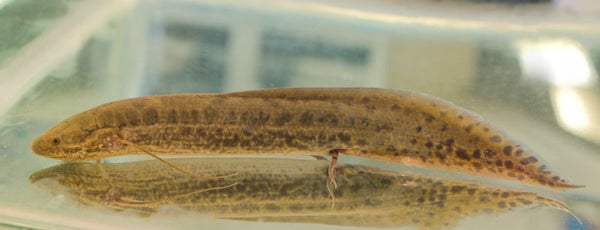
Lungfish are thought to be related to the first creatures that crawled out of the water to colonize land. But because the lungfish has scrawny, whiplike fins, scientists thought that the ability to walk must have evolved later in terrestrial quadrupeds.
"If you just looked at the skeleton of the lungfish, you would think it's impossible for it to walk," says Heather King, a doctoral student at the University of Chicago. "It doesn’t have a sacrum, which was thought necessary for the animal to lift itself off the ground, and it doesn't have anatomical feet." Yet, after observing the strange movements of a co-worker's pet lungfish, King was inspired to take a closer look at lungfish locomotion.
In a study published this week in Proceedings of the National Academy of Sciences, King used video cameras to observe and quantify the movements of African lungfish. The footage reveals that the fish uses its hind fins to push its body up from the substrate and propel itself forward.
On supporting science journalism
If you're enjoying this article, consider supporting our award-winning journalism by subscribing. By purchasing a subscription you are helping to ensure the future of impactful stories about the discoveries and ideas shaping our world today.
This rudimentary walking style sheds light on the water-to-land transition. During the transition from water to terra firma, organisms developed alternating limb movements, grew toes and began using a substrate for propulsion. But until now, scientists haven't been able to piece together the sequence of these events. The new findings support the theory that walking first arose underwater, preceding the move onto land and the development of toes and limbs adapted to land perambulation.
King says she now hopes to study the biomechanics of how the sacrum-less, footless creature is able to propel itself.
—Sarah Fecht