
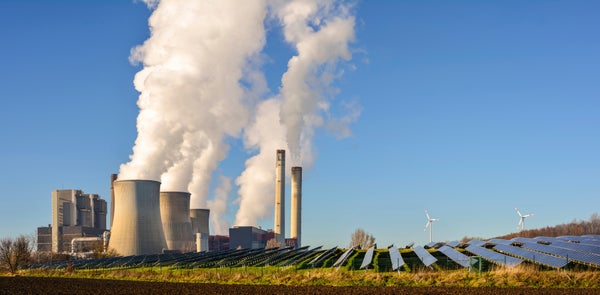
If the world wants to keep the lights on, leaders must tackle threats to global water supply, according to the latest prognosis from the World Energy Council.
In a report published yesterday based on the findings of over 140 experts internationally, the group calls for swift action to ensure resilient energy infrastructure.
Based on last year’s U.N. projections of a 40 percent global shortfall of water availability by 2030, the report focuses on water’s crucial role in power generation. After agriculture, energy consumes the second largest amount of fresh water, and 98 percent of power produced requires water, the report found.
On supporting science journalism
If you're enjoying this article, consider supporting our award-winning journalism by subscribing. By purchasing a subscription you are helping to ensure the future of impactful stories about the discoveries and ideas shaping our world today.
As water-stressed areas see population growth and more economic activity, their risks of not delivering enough energy and food also increase. Changes to climate and shifting rainfall patterns heighten that uncertainty.
“These things have a trickle-down effect. Without having an understanding of water, it’s difficult to have a good risk management and finance resilient energy infrastructure,” said Katrina Kelly, one of the report’s lead authors and project manager at the World Energy Council.
Meanwhile, the lack of institutional knowledge and local modeling tools inhibit governments’ ability to tackle an increasingly complex picture.
“Power plants across the world could be affected by changes in precipitation patterns, which are combining with increasing competition between water users to adversely affect the resilience of energy services,” said Christoph Frei, secretary general of the World Energy Council, in a statement.
Some say global water threat is overblown
While scientists agree the issue is crucial, not all of them consider water under dire threat across the world.
“I do not think that there is a crisis, and I certainly do not think there is a global crisis,” said Kate Brauman, lead scientist at the University of Minnesota’s Institute on the Environment.
Though the report does highlight an important issue, Brauman said, its message may be overblown.
That’s because water is largely a local issue, according to Brauman. In other words, the wet stuff doesn’t tend to move from one water table to another. Cutting back on water use in New York City doesn’t fix the drought in Los Angeles.
“There are places where we’re using all or nearly all of our available water, but those are localized places on the globe,” she said. “So by the end of the day, to say something like, on a global scale, we’re using more water than we have or we’re running out of water” doesn’t paint the situation correctly, said Brauman.
Many nuances exist in the water picture. For instance, water usage doesn’t always increase to mirror population or economic growth.
“As cities grow and densify, you almost always see reductions in per-capita water use,” Brauman said.
A complicated numbers game
When cities grow, they often update infrastructure, fixing up leaky pipes and resulting in huge water savings, explained Brauman. Also, people who live in urban areas don’t tend to have lawns—another big consumer of water.
Then there’s the distinction between water withdrawal and water consumption. It’s a big difference, experts said.
Whereas some industries, like agriculture, take water out of the system, “consuming” it to water crops, others “withdraw” the water but put it back into the system.
For example, a power plant that uses water to cool its condensers might pull water from a river, run it through the plant and release that same water back into the river. The water leaving the plant is warmer, but it still re-enters the river.
Power plants account for about 45 percent of withdrawals in the United States, but in terms of consumption, their impact is much smaller, said Jerad Bales, the chief scientist for water at the U.S. Geological Survey. Currently, we don’t have good information on consumptive use, said Bales.
“That’s a hard number to get,” he said.
And water is a complicated numbers game. The math gets even thornier when scientists try to cast projections into the future. The longer the time scale, the more difficult it becomes to accurately predict water conditions.
While he lauded researchers’ efforts, Bales said water science still has a long way to go before it can offer projections decades down the road.
“If you get a weather forecast for next Thursday, are you going to believe it?” Bales asked. “Think about not just a weather forecast, but a weather and water forecast.”
Still, he said, water problems aren’t merely conjecture.
“If we have a billion people who don’t have access to clean and safe water, that’s a crisis—and that’s today.”
Reprinted from Climatewire with permission from Environment & Energy Publishing, LLC. www.eenews.net, 202-628-6500
