
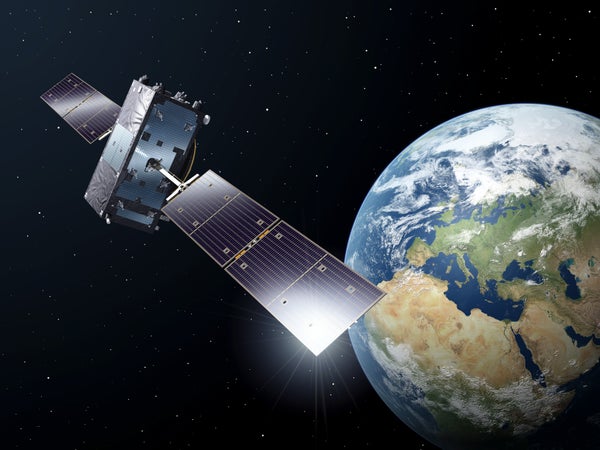
In August 2014 a rocket launched the fifth and sixth satellites of the Galileo global navigation system, the European Union's $11-billion answer to the U.S.'s GPS. But celebration turned to disappointment when it became clear that the satellites had been dropped off at the wrong cosmic “bus stops.” Instead of being placed in circular orbits at stable altitudes, they were stranded in elliptical orbits useless for navigation.
The mishap, however, offered a rare opportunity for a fundamental physics experiment. Two independent research teams—one led by Pacôme Delva of the Paris Observatory in France, the other by Sven Herrmann of the University of Bremen in Germany—monitored the wayward satellites to look for holes in Einstein's general theory of relativity.
“General relativity continues to be the most accurate description of gravity, and so far it has withstood a huge number of experimental and observational tests,” says Eric Poisson, a physicist at the University of Guelph in Ontario, who was not involved in the new research. Nevertheless, physicists have not been able to merge general relativity with the laws of quantum mechanics, which explain the behavior of energy and matter at a very small scale. “That's one reason to suspect that gravity is not what Einstein gave us,” Poisson says. “It's probably a good approximation, but there's more to the story.”
On supporting science journalism
If you're enjoying this article, consider supporting our award-winning journalism by subscribing. By purchasing a subscription you are helping to ensure the future of impactful stories about the discoveries and ideas shaping our world today.
Einstein's theory predicts time will pass more slowly close to a massive object, which means that a clock on Earth's surface should tick at a more sluggish rate relative to one on a satellite in orbit. This time dilation is known as gravitational redshift. Any subtle deviation from this pattern might give physicists clues for a new theory that unifies gravity and quantum physics.
Even after the Galileo satellites were nudged closer to circular orbits, they were still climbing and falling about 8,500 kilometers twice a day. Over the course of three years Delva's and Herrmann's teams watched how the resulting shifts in gravity altered the frequency of the satellites' superaccurate atomic clocks. In a previous gravitational redshift test, conducted in 1976, when the Gravity Probe-A suborbital rocket was launched into space with an atomic clock onboard, researchers observed that general relativity predicted the clock's frequency shift with an uncertainty of 1.4 × 10⁻⁴.
The new studies, published last December in Physical Review Letters, again verified Einstein's prediction—and increased that precision by a factor of 5.6. So, for now, the century-old theory still reigns.
