
Finding ways to alert communities of pending climate disasters can yield a tenfold return on investment by avoiding deaths and injuries, according to the United Nations.
Those methods can range from satellites that better predict extreme weather events to location-based text messaging systems that can warn at-risk communities of imminent storms, floods, wildfire and other extreme events.
“Early Warning Systems are a proven and feasible means of helping people to adapt to climate change ... by saving lives and livelihoods in the case of extreme weather events such as ever more intense and frequent storms and floods," U.N. officials said this week in a release. “And smart, innovative technologies are playing an increasingly important role in making them effective.”
On supporting science journalism
If you're enjoying this article, consider supporting our award-winning journalism by subscribing. By purchasing a subscription you are helping to ensure the future of impactful stories about the discoveries and ideas shaping our world today.
In fact, early warning systems are among the most cost-effective adaptation tools to mitigate deaths and injuries from climate disasters around the world, according to the Technology Executive Committee of the U.N. Framework Convention on Climate Change.
The return-on-investment calculation emerged from a “deep dive” discussion last month between U.N. officials and climate stakeholders in Rio de Janeiro, and it follows U.N. Secretary-General António Guterres’ March 2022 directive that the world’s entire population have access to disaster early warning systems by 2027.
Over the past decade, climate disasters have killed tens of thousands of people and cost trillions of dollars.
A January report from the British nonprofit Christian Aid estimated that the world’s 10 largest natural disasters in 2022 had an economic toll of more than $168 billion; Hurricane Ian alone accounted for $100 billion.
Deaths and displacement, however, were much higher in developing countries. Christian Aid’s analysis showed that 10 disasters last year took the lives of at least 3,275 people and displaced tens of millions more.
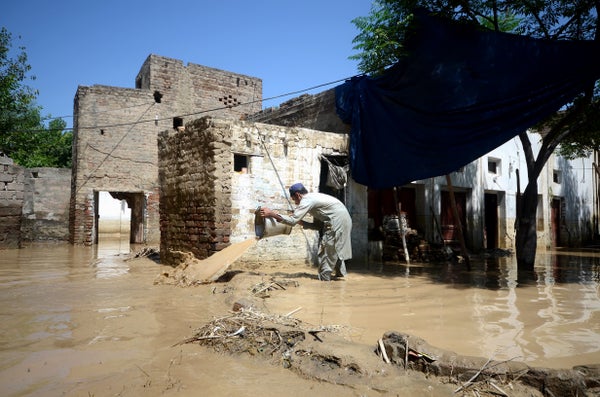
Extreme flooding caused by monsoon rains in Pakistan, for example, contributed to the deaths of nearly 1,740 people and drove 7 million from their homes, Christian Aid found.
A post-disaster scientific assessment found that climate change contributed to the severity of the rain and flooding (Climatewire, Sept. 16, 2022). It also noted that Pakistan has invested in early warning technologies through a $120 million World Bank grant issued in 2016 to help the country’s Sindh province.
U.N. officials have said 7 million people in the province now receive more accurate and timely warning notifications. But the post-flood scientific report noted that “the ‘flash’ nature of much of the [2022] flooding, and large amount of water, may also have significantly limited the effectiveness of any early warnings even if the systems were in place.”
A recent meeting of the U.N. Technology Executive Committee identified five innovations that could improve early warning systems. They include artificial intelligence “to predict collective behavior before and during emergencies, allowing [for] better planning, and location-based wireless phone and texting capabilities.”
In addition, officials recommended greater use of the “internet of things” to “enhance the effectiveness of early warning systems in human settlements for both public and private buildings.” A prime example of such a system is in South Africa, where a networked electronic alarm system reduces wildfire risk by providing live monitoring and text alerts to residents.
Reprinted from E&E News with permission from POLITICO, LLC. Copyright 2023. E&E News provides essential news for energy and environment professionals.