
As with most disasters, when the history of the COVID pandemic is written, there will be a fair amount of finger-pointing involved.
Much more could have been done to mitigate the coronavirus impact in the United States, but in reality, there are very few countries that totally escaped this scourge. Scientific research has provided a lot of new knowledge by which to manage the pandemic—and of course, the development of vaccines in record time is welcome news. But even with vaccines, success in controlling this virus continues to depend in large measure on human behavior. Science cannot take on these big challenges solely through medical fixes; rather it needs social and behavioral science to have a seat at the table as well. History is also a useful guide for understanding the present.
Anthropology is a broad field that has long focused on issues having to do with social organization, cultural meaning and human behavior. And as a professor of history and anthropology at the University of California, Berkeley, in addition to my role at the New York Academy of Sciences, I have seen how classic fieldwork methods of ethnography—based on close observation of patterns and structures of social meaning—have revealed important insights into why modernity has accommodated enormous variation of thought and behavior.
On supporting science journalism
If you're enjoying this article, consider supporting our award-winning journalism by subscribing. By purchasing a subscription you are helping to ensure the future of impactful stories about the discoveries and ideas shaping our world today.
The general assumption that modern societies are ready to “follow the science” is no more readily confirmed by historical example or anthropological fieldwork than it has been by our direct experience of widely disparate reactions to the current pandemic.
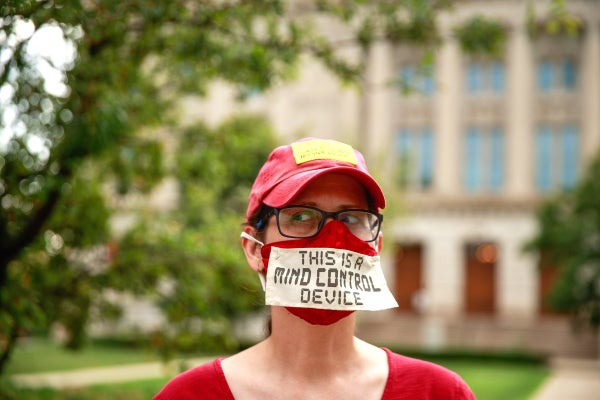
We should have learned from the responses to the great pandemic of 1918–19, when some cities did much better than others in containing the spread of a virus that ultimately killed close to 50 million people around the globe. A combination of distrust in government and science played havoc with government efforts to control the flu by wearing masks. Despite medical advice, many Americans not only refused to comply, they engaged in major protests against mask mandates.
The polio pandemic of the 1950s is another often-ignored “teachable” moment. On the surface, it would seem that it was a scientific, medical and policy success story. But the reality is closer to what we are seeing with COVID.
In 1954, when polio was at its most virulent, the Eisenhower administration declared that every child should receive the polio vaccine being developed at that time. But there was no cohesive plan at the federal level to make that happen, so the mandate was not a success. In addition, lack of oversight regarding the quality of the vaccine manufacturing process led to some children becoming sick or dying. Limited resources to administer the vaccine on a national scale were another problem, and it was not until Eisenhower’s signing of the Polio Vaccination Assistance Act in 1955 that there were enough federal funds available for a national public inoculation program. Such massive confusion resulted in public distrust that took years to abate.
When the sociologist Alondra Nelson was named as the new deputy director of the Office of Science and Technology Policy, she noted that the pandemic had “held up a mirror to our society, reflecting … the inequality we’ve allowed to calcify.” She also noted that “science is a social phenomenon.” This implies not just that science requires real insight into the society with which it interacts, but also that it is forged in relationship to social forces and meanings. Social science can assist us in understanding social reactions to scientific knowledge, as well as in ensuring that science becomes aware of its own social biases and interests.
Science gains its authority through constant testing and perpetual revision. To the outside world, science often appears to be confused, subject to doubt, arbitrarily adjusting its findings and its recommendations. Early in the pandemic we were told to scrub all surfaces rather than wear masks; now we know that aerosol droplets in the air are by far the most significant vector of viral transmission. Scientists need to do a better job of managing how they communicate what they know, and how they come to know it.
Human behavior evolves as our knowledge increases, but we are all subject to our own ways of construing this knowledge. Because of the pervasive influence of social media, new knowledge is often overwhelmed by misinformation that further confuses us and provides easy access to conspiracy theories and alternative facts. In order to ensure that scientific advances work not just to create new medicines but to help lead to a healthier and more just world, we need to ensure that science and social science work hand in hand as well.
