
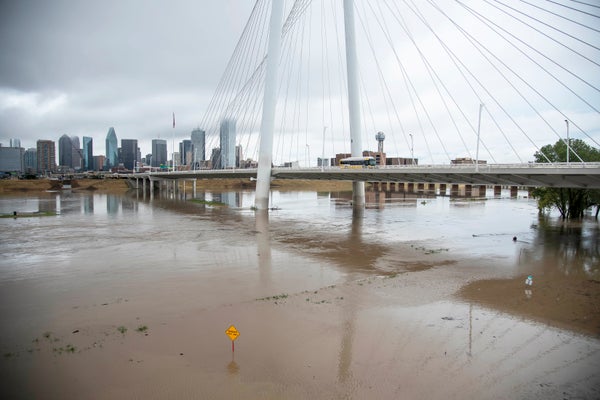
CLIMATEWIRE | The Dallas area is still reeling from record-breaking downpours that triggered flash floods across northeastern Texas last week. The event swamped houses, submerged vehicles and prompted hundreds of emergency rescues. At least one death has been reported so far.
The sheer volume of rain was stunning, with some locations receiving more than a foot. But the deluge was all the more surprising because Dallas has been choked by severe drought for months.
It’s a phenomenon often referred to by scientists as “weather whiplash.” And Texas isn’t the only place it’s happened this summer. Monsoon rains triggered flash floods in Arizona and New Mexico in the past week, even as the Southwest continues to suffer under a decadeslong drought.
On supporting science journalism
If you're enjoying this article, consider supporting our award-winning journalism by subscribing. By purchasing a subscription you are helping to ensure the future of impactful stories about the discoveries and ideas shaping our world today.
It’s not just the United States, either.
England experienced its driest July in decades, only to be pummeled by heavy rains and flash floods in London and other southern parts of the country in the past week. France, too, has experienced one of its worst droughts on record this summer — yet it’s also been slammed by severe storms, triggering recent floods in Paris, Marseilles and other areas across the country.
These may seem like head-spinning events, but they’re not entirely uncommon. And they may happen more frequently as the planet keeps on warming.
“With continued climate change, we might see increases in such seesaw events,” said Xiaogang He, a hydrologist at the National University of Singapore, in an email.
Climate change is expected to increase the separate risks of both droughts and extreme precipitation events in many parts of the world, he noted. And other changes in large-scale atmospheric circulation patterns, influenced by global warming, may also make weather patterns more variable, more extreme and longer lasting in the future.
These factors may increase the risk of back-to-back dry and wet events.
Some of He’s own research has focused on the “seesaw” effect when dry spells are followed by wet spells. A
2020 paper he co-authored with colleague Justin Sheffield found that around 11 percent of all droughts worldwide are followed in the next season by strong precipitation.
Some distinct hot spots popped out. Southern North America and Europe had the greatest frequency of seesaw events worldwide.
And in some places, including Southern North America, these events seem to be happening more often over time.
The study doesn’t delve into the causes for the increase, so it can’t say for sure that climate change is the culprit for the changes that have happened. But figuring out whether these hot spots have been influenced by warming in the past — and whether they may serve as a warning for the future — is a “critical question," he said.
‘Very big alarm’
Other studies have uncovered similar trends.
A
paper published earlier this year in Environmental Research Communications looked at “consecutive dry-wet events” around the globe — extreme dry spells followed by extreme precipitation. It revealed several hot spots for these events, concentrated in North America, Europe and Australia.
The study also found that the recovery period between dry spells and wet spells is shortening over time. Wet events are happening sooner after droughts, with less time in between the two extremes.
That makes it harder for communities to cope with the aftermath of both disasters.
“When we talk about dry and wet extremes, it has a very significant impact as well on the society and the environment,” said the study’s lead author, Mamunur Rashid, a climate adaptation scientist at The Nature Conservancy and an assistant professor at the University of Southern Mississippi beginning in October.
To begin with, droughts can make extreme rains worse when they happen back to back. They prime the landscape for flash floods.
Dry ground often becomes harder and less porous, making it more difficult for water to seep into the soil. It simply runs off the surface. Wildfires — often a byproduct of drought — can further damage this soil and raise these risks even higher.
This means extreme rain doesn’t necessarily end a drought when it happens. If the water runs right off, the soil can remain parched after the rains end.
Back-to-back droughts and extreme rains also pose a threat to human infrastructure. Dams and reservoirs are prime concerns.
During droughts, water managers typically try to operate reservoirs at optimal levels to provide water to communities downstream. If heavy storms unexpectedly roll in and dump water on the reservoir, they can cause mayhem.
The Oroville Dam crisis of 2017 is a prime example, Rashid pointed out.
In early 2017, a longstanding drought in California was interrupted by extreme precipitation. As heavy rainfall pounded the region in February, the Oroville Dam’s main spillway and emergency spillway both failed. Officials ordered mass evacuations in fear of a total spillway collapse, which would have unleashed catastrophic floodwaters on downstream communities.
Ultimately, the dam’s operators were able to bring the lake’s water levels back under control. Still, the event “was a very big alarm,” according to Rashid. It laid bare the difficulties of managing water resources in a climate increasingly prone to rapid mood swings.
Seesaw events present water managers with difficult trade-offs, added He of the National University of Singapore — storing up water to feed long-term demand in drought-prone landscapes versus releasing water to deal with short-term flood risks during extreme rains.
More research is needed to fully understand how and where the risks of weather whiplash will change as the planet keeps on warming. But the threat that these events may worsen over time should be a call to action for policymakers, Rashid said. There should be better bridges between scientists, engineers and decisionmakers so that future infrastructure projects can take these risks into account.
“This is really a very, very new topic, and it has a lot of implications and it has a lot of impact on our society, on our infrastructure, on our environment,” Rashid said. “We have a lot of things to do in that relation, looking into the future.”
Reprinted from E&E News with permission from POLITICO, LLC. Copyright 2022. E&E News provides essential news for energy and environment professionals.