
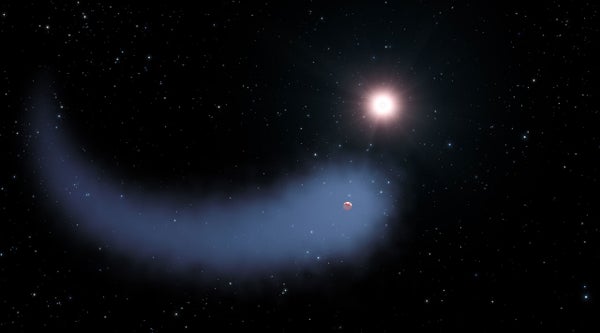
GJ 436b keeps getting weirder.
Astronomers already knew that the Neptune-mass exoplanet is evaporating; a few years back, a research team spotted the huge, comet-like tail of gas that streams behind GJ 436b as it orbits its small, dim host star.
Now, a new study reveals there's something very off about that orbit: It's highly elliptical and takes the alien world over the star's poles. (The "normal" case, exhibited by all eight officially recognized planets in Earth's solar system, is a relatively circular path in line with the star's equatorial plane.) [The Strangest Alien Planets]
On supporting science journalism
If you're enjoying this article, consider supporting our award-winning journalism by subscribing. By purchasing a subscription you are helping to ensure the future of impactful stories about the discoveries and ideas shaping our world today.
"This planet is under enormous tidal forces because it is incredibly close to its star, barely 3 percent of the Earth-sun distance," study lead author Vincent Bourrier, an astronomer at the University of Geneva in Switzerland, said in a statement.
"The star is a red dwarf whose lifespan is very long," Bourrier added. "The tidal forces it induces should have since circularized the orbit of the planet, but this is not the case!"
Bourrier and his colleagues figured this out after analyzing spectrographic observations of GJ 436b, which lies 33 light-years from Earth in the constellation Leo. These observations were made by the High Accuracy Radial velocity Planet Searcher (HARPS) instrument at the European Southern Observatory's La Silla Observatory in Chile, and HARPS-N (for Northern Hemisphere), which is installed at the Roque de los Muchachos Observatory in the Canary Islands.
The team's calculations also suggest that GJ 436b did not always sport its peculiar tail. The alien world probably once orbited much farther away from its parent star but was pushed inward at some point, likely by an as-yet-undiscovered sibling planet, study team members said.
"Our next goal is to identify the mysterious planet that has upset this planetary system," Bourrier said.
The new study was published online Monday (Dec. 18) in the journal Nature.
EDITOR'S RECOMMENDATIONS
Copyright 2017 SPACE.com, a Purch company. All rights reserved. This material may not be published, broadcast, rewritten or redistributed.