
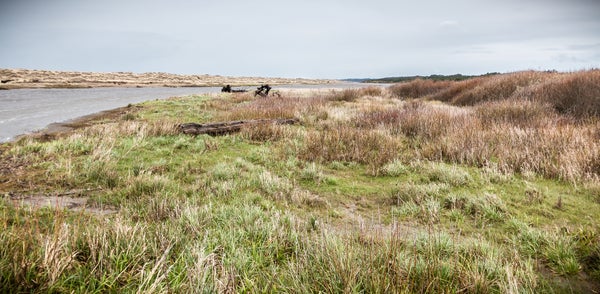
The Pacific Coast could see several feet of sea-level rise by the end of this century, and one of its most unique and valuable ecosystems—its salt marshes—may all but disappear in the process.
By the year 2110, all the existing marshland in California and Oregon could be underwater, according to new research in the journal Science Advances. And more than two-thirds of all the wetlands in Washington state could meet the same fate. That's assuming about 4 feet of sea-level rise by the end of the century—what recent reports predict for the region under moderate to severe future climate change.
Even the marshes that remain won't be the same as they were before. While today's wetlands contain a mix of different ecosystems, which are adapted to different conditions, only plants that can tolerate the most frequent flooding—habitats known as "low" marshes—would remain in the future under this scenario.
On supporting science journalism
If you're enjoying this article, consider supporting our award-winning journalism by subscribing. By purchasing a subscription you are helping to ensure the future of impactful stories about the discoveries and ideas shaping our world today.
"You may have a wetland 50 or 100 years from now, but it may look different," said Karen Thorne, a researcher with the U.S. Geological Survey and the study's lead author. "It's going to have a different sort of marshy plant community."
While the destruction of buildings and infrastructure may seem like the biggest problem caused by rising seas, damage to coastal wetlands is a serious concern for scientists. Salt marshes provide a wide variety of important ecosystem services to human communities—they help buffer the coastline against storms and erosion, absorb vast amounts of carbon, and provide habitat for valuable fisheries, as well as many other plants and animals. Losing these wetlands can leave the shoreline more vulnerable to the impact of climate change, while also releasing large quantities of carbon into the atmosphere.
The new research used a specialized wetland model to investigate the impact of future climate change along the Pacific coast, assuming anywhere from a few inches to more than 4 feet of sea-level rise by the end of the century. Focusing on 14 sites along the California, Oregon and Washington state shorelines, it suggests catastrophic wetland losses under higher-end projections.
But even under more optimistic scenarios, significant swaths of marshland are likely to drown. Under a moderate scenario, assuming between 2 and 3 feet of sea-level rise up and down the coast, 95 percent of "high" marshes—the types of wetland ecosystems that can tolerate the least amount of flooding—will still disappear.
In some parts of the country, marshes can adjust to sea-level rise by migrating to higher ground, the researchers note. But for most sites along the Pacific coast, it's a slim possibility. Throughout much of California, the encroachment of cities or agricultural land has left no space for the marshes to move into. And farther north, the coastal landscape becomes too steep for much migration to occur.
"Wetlands won't migrate up the side of a mountain," Thorne noted.
That means most of what disappears along the Pacific Coast in the next 100 years will be lost for good.
That said, there's still some time for action, the researchers suggest. First, with stringent climate mitigation—which may limit sea-level rise to a few inches, rather than a few feet—wetland losses are likely to be far less severe.
Even under more serious scenarios, the worst losses are likely to occur toward the end of the century. That means policymakers could take steps to protect their wetlands in the meantime, by creating more space along the coast for wetlands to move into, or by artificially bolstering them with added sediments.
"If you look at the final result, it looks pretty dismal—but if you look at it all together, there is time," Thorne said. "The way I describe these results to people is this is what will happen if we do nothing, absolutely nothing. So there is time for us to figure out some solutions and see if we can change the predictions."
Reprinted from Climatewire with permission from E&E News. E&E provides daily coverage of essential energy and environmental news at www.eenews.net.