
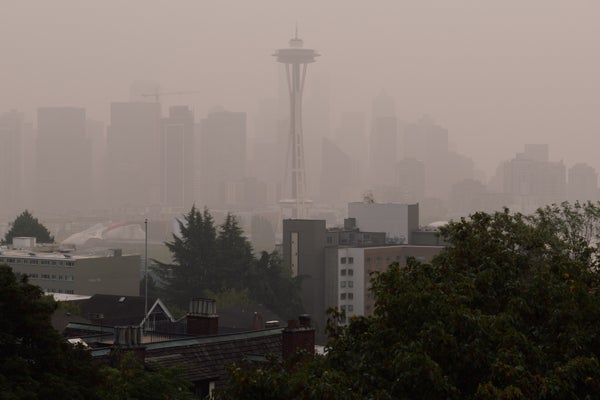
A rise in pollutants from forest fires in the Pacific Northwest has begun to reverse a decade of clean air gains in the U.S., according to a new study from the National Center for Atmospheric Research.
Western forests have become increasingly dry as the climate changes, resulting in larger plumes of smoke moving eastward annually across the U.S. Altogether, these plumes expose as many as 130 million people in the Pacific Northwest, central U.S. and Northeast to harmful chemicals and tiny particles, researchers detail in the study, which was published this week in Nature Communications.
“Wildfire emissions have increased so substantially that they’re changing the annual pattern of air quality across North America,” explained Rebecca Buchholz, an atmospheric chemist and the lead author of the study. “It’s quite clear that there is a new peak of air pollution in August that didn’t used to exist.”
On supporting science journalism
If you're enjoying this article, consider supporting our award-winning journalism by subscribing. By purchasing a subscription you are helping to ensure the future of impactful stories about the discoveries and ideas shaping our world today.
The scientific team included researchers not only from NCAR, but also from the University of Colorado Boulder, Colorado State University, Columbia University, China’s Tsinghua University and NASA. They used satellite data to track carbon monoxide levels in the smoke as it moved eastward. Carbon monoxide is a prime indicator that a plume contains more dangerous materials, caused by incomplete combustion. They include chemicals such as furan, benzene and formaldehyde, as well as aerosols in microscopic particles that can penetrate human lungs.
“It is a fingerprint pointing to health issues far downwind from these fires,” Buchholz explained in an interview.
She said researchers were able to eliminate other potential causes of the pollution, such as emissions from northern China, because satellite data showed that China’s efforts to reduce pollution began taking effect around 2010.
But from 2012 to 2018, the NCAR study showed, pollution levels across the northern U.S. were rising, despite the anti-pollution laws and regulations for cleaner-burning cars that had resulted in air quality improvement a decade earlier.
Records of respiratory deaths in Colorado — in the middle of the eastward-moving smoke plume — further defined the problem. These deaths had been declining in the month of August from 2002 to 2011. But from 2012 to 2018, they “increased significantly,” according to the study.
The evidence pointed to the forest fires in the Pacific Northwest, as well as in adjacent regions in Canada and Northern California.
“I wouldn’t have been able to do this study without long records,” Buchholz said, noting that two instruments on NASA’s Terra satellite, launched in 1999, helped the team track the carbon monoxide and identify the other pollutants as they moved.
One of two monitoring devices in the Terra satellite is nearing the end of its life, Buchholz said. Three new geostationary satellites from Asia and Europe — and one soon to be launched in the U.S. — will help track future plumes.
In future years, the study suggested, August’s eastward plume of smoke could include emissions from fires in Northern California, where the drought has become more severe. That could spread the health problems to even more people.
Reducing the health impacts of future August smoke plumes “will take the combined efforts of trying to address climate change and also managing the fires in the Northwest Pacific,” Buchholz said.
Reprinted from E&E News with permission from POLITICO, LLC. Copyright 2022. E&E News provides essential news for energy and environment professionals.