Whale Song Revolution

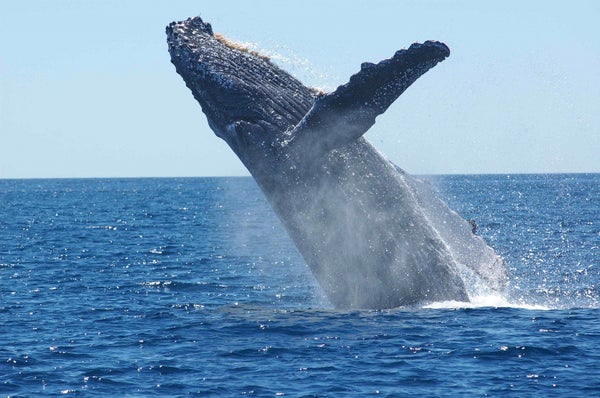
Humpback whale

Join Our Community of Science Lovers!


On supporting science journalism

If you're enjoying this article, consider supporting our award-winning journalism by subscribing. By purchasing a subscription you are helping to ensure the future of impactful stories about the discoveries and ideas shaping our world today.


When visiting their breeding grounds, male humpback whales do not swim in silence. Rather, they sing. The tune they carry depends on where they live: populations within an ocean basin sing similar songs, but populations in different ocean basins generally sing different songs. All males in a population, however, produce the same song, which changes over time. Previous studies of whale songs had suggested that such change occurs on an evolutionary scale--that is, gradually. But in this week's issue of the journal Nature, researchers describe revolutionary song change in a population of whales in the Pacific Ocean off Australia's east coast. The radical nature of this transformation, they report, "is unprecedented in animal cultural vocal traditions and suggests that novelty may stimulate change in humpback whale songs."

Michael J. Noad of the University of Sydney and his colleagues eavesdropped on whales off southeast Queensland during migrations between 1995 and 1998, analyzing 1,057 hours of song. (Singing is presumably a form of sexual display, but whether the males are serenading females or warning other males to stay away is not known.) In the first two years the team detected modest, evolutionary change in the tune, but they noted that two of the whales were singing entirely different songs. In 1997 more whales picked up the new song-- most sang either the new song or the old song, but a few produced an intermediate version with themes from both types. By 1998 the researchers heard only the new song. Intriguingly, that song was almost exactly the same as the song of humpbacks traveling along Australia's west coast in 1996. The team thus concludes that a small number of singers from the west coast population must have joined the east coast population, bringing their catchy west coast ditty with them.

Kate Wong is an award-winning science writer and senior editor for features at Scientific American, where she has focused on evolution, ecology, anthropology, archaeology, paleontology and animal behavior. She is fascinated by human origins, which she has covered for nearly 30 years. Recently she has become obsessed with birds. Her reporting has taken her to caves in France and Croatia that Neandertals once called home to the shores of Kenya’s Lake Turkana in search of the oldest stone tools in the world, as well as to Madagascar on an expedition to unearth ancient mammals and dinosaurs, the icy waters of Antarctica, where humpback whales feast on krill, and a “Big Day” race around the state of Connecticut to find as many bird species as possible in 24 hours. Wong is co-author, with Donald Johanson, of Lucy’s Legacy: The Quest for Human Origins. She holds a bachelor of science degree in biological anthropology and zoology from the University of Michigan. Follow her on Bluesky @katewong.bsky.social

More by Kate Wong

It’s Time to Stand Up for Science

If you enjoyed this article, I’d like to ask for your support. Scientific American has served as an advocate for science and industry for 180 years, and right now may be the most critical moment in that two-century history.

I’ve been a Scientific American subscriber since I was 12 years old, and it helped shape the way I look at the world. SciAm always educates and delights me, and inspires a sense of awe for our vast, beautiful universe. I hope it does that for you, too.

If you subscribe to Scientific American, you help ensure that our coverage is centered on meaningful research and discovery; that we have the resources to report on the decisions that threaten labs across the U.S.; and that we support both budding and working scientists at a time when the value of science itself too often goes unrecognized.

In return, you get essential news, captivating podcasts, brilliant infographics, can't-miss newsletters, must-watch videos, challenging games, and the science world's best writing and reporting. You can even gift someone a subscription.

There has never been a more important time for us to stand up and show why science matters. I hope you’ll support us in that mission.

Thank you,

David M. Ewalt, Editor in Chief, Scientific American

Subscribe