
When I was a kid, I sometimes played basketball on a schoolyard court next to a brick wall. Bouncing the ball, I’d notice its sound repeated a split second later from the wall’s direction. It sounded a little different, but it was clearly the same noise the ball made when it hit the blacktop, just delayed.
I had discovered echoes. Nerdy kid that I was, I reasoned that the ball’s sound was traveling to the wall, bouncing off and then coming back to me. Later I’d learn that if you knew the speed of that sound (roughly 1,200 kilometers per hour) and the length of the delay, you could calculate the distance to the wall.
Of course, nature figured it out somewhat earlier than I did; many species of animals use this fact to map out their surroundings via echolocation. Astronomers can do this kind of mapping, too, but we don’t use sound echoes. We use light echoes. Like sound, light moves at a finite speed. It’s very fast, but on the huge scales astronomers study, it’s actually rather slow. The light echoes we see in the sky can take years or even centuries to reach us.
On supporting science journalism
If you're enjoying this article, consider supporting our award-winning journalism by subscribing. By purchasing a subscription you are helping to ensure the future of impactful stories about the discoveries and ideas shaping our world today.
What is a light echo? Imagine that instead of a bouncing basketball, there’s a star in space that suddenly and rapidly brightens, as happens when a massive star explodes at the end of its life to create a supernova. The flash of light expands in a sphere, racing away from the site of the explosion at about 300,000 kilometers per second. That’s a billion kilometers per hour!
The flash of light will define a spherical shell, akin to the thin wall of a bubble, that is a certain distance from the explosion at any given moment. After one hour, for example, the light shell is a billion kilometers from the site. Anyone at the same distance as the shell will see the start of the event at the same time. If you’re farther away from the blast than the shell is, you won’t see the explosion, because the light hasn’t reached you yet.
Besides simply being cool to watch, light echoes can tell us about the environment around a supernova.
The “echo” comes in when we adjust this idealized scenario to account for real-world complexities such as the likelihood of material surrounding the light source. Let’s imagine, for instance, that there is a thin shell of gas around a supernova that is one light-year in radius and that we’re witnessing the blast from much farther away, maybe thousands of light-years (safety first; wouldn’t want to be too close to an exploding star). The supernova detonates, unleashing an expanding wave of light. One year after the explosion, that light hits all the gas in the enveloping shell simultaneously. But our view from afar means we don’t see the entire shell of gas light up at once.
Instead the part of the shell we first see illuminated is its point nearest to us, directly on a line with the supernova. That’s because after the gaseous shell lit up, the light from that spot had the shortest distance to travel to reach us across space, so it arrived first.
Next we see a ring of light seeming to expand from that initial spot as the supernova’s light traverses parts of the gassy shell that are slightly farther away from us. We then witness a surprising sight: the expanding ring gets bigger and bigger until it reaches the maximum size of the shell, its diameter, and then begins to shrink. As it moves across the other side of the spherical shell from our line of sight, the light echo illuminates progressively smaller rings until it’s a dot, then poof! It’s gone.
Even this more complicated scenario is rather unrealistic. More likely, a supernova occurs inside a galaxy loaded with numerous, scattered clouds of gas and dust. As the wave of light expands, it will illuminate these clouds, creating more ornate light echoes that can be many light-years in size.
The geometry of a light echo was first quantified by French astronomer Paul Couderc in 1939—something I referenced for my own Ph.D. work analyzing how supernova 1987A lit up its surrounding gas. What Couderc found is that an observer off to one side sees the echo expanding as a thin paraboloidal shell—a thimble- or cup-shaped geometry, with the observer looking down into the opening and the source of light centered in it near the apex. At any given moment, a distant observer will see anything lying on that shell as lit up.
Keep in mind, though, that we are looking down the axis of that shell, which has a circular cross section. The material we see lit up will therefore look like a circle no matter what the actual 3D distribution is. Any dust clouds on that shell will be illuminated at the exact same time, even if they’re widely separated in space. What we see from Earth is a circle in the sky expanding over time—or even multiple circles if gas gets lit up and takes some time to fade (in general, once a gas cloud is hit by, say, ultraviolet light, it reemits that light at lower wavelengths over weeks or months).
And this exact phenomenon has been seen: SN2016adj exploded in the nearby galaxy Centaurus A, creating an expanding circular light echo that was captured by the Hubble Space Telescope (and turned into an amazing animation by community scientist Judy Schmidt). And my thanks to astronomer Kirsten Banks of Australia’s Swinburne University of Technology for reminding me about SN2016adj.
Besides simply being cool to watch, light echoes can tell us about the environment around a supernova; massive stars explode young, before they can move out of the cloud of gas and dust where they were born. The light echo illuminates that material, giving us insight into its conditions and even its 3D structure when the star was forming.
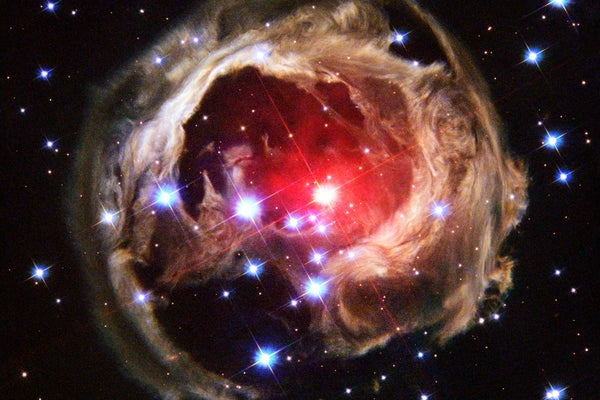
This effect was demonstrated in a ridiculously dramatic way when the star V838 Monocerotis underwent a tremendous outburst seen in 2002. Hubble images taken over time showed the dust around it expanding and changing rapidly, but this motion was an illusion: it was the light echo expanding through stationary dust, illuminating different material as it swept through. The animation of it is as bizarre and unearthly as anything I have ever seen.
Remember, that dust is not physically expanding; it’s just being lit up by the flash of light. Scientists analyzing these data came to the rather startling conclusion that the V838 Monocerotis event was caused by two stars colliding and merging, blasting out a fierce pulse of light that illuminated the surrounding material. Careful measurement of the expanding light echo was used to determine V838’s distance from us: about 20,000 light-years.
Light echoes are peculiar phenomena that at first seem nothing more than a curiosity—until, that is, you start looking into the math and physics. Then they become an important tool we can use to probe space. I’m fascinated by how nature hands us these gifts that help us explore the universe around us, freeing data we can examine to get a better understanding of the cosmos we live in—and, at the same time, feeding our sense of wonder and awe.
My thanks to astronomer Kirsten Banks for reminding me about SN2016adj.