
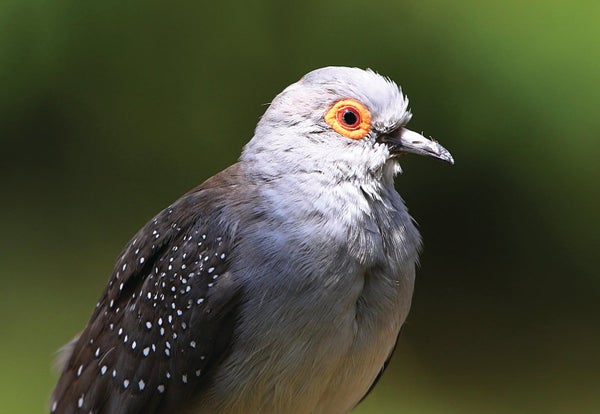
Picture a pigeon perched on a telephone wire. Ready for takeoff, it raises its wings, springs into the air and flaps away, perhaps with the intention of leaving its calling card on your car's windshield. This series of actions is so commonplace that you probably do not pay it much attention. But University of Manchester biomechanical engineer Ben Parslew does. He is trying to design robots that can jump like birds.
Most conventional robots roll around on wheels, constraining mobility. There is a need for more agile robots that “can jump over obstacles or debris in cluttered environments,” Parslew says. To design such a machine, he turned to nature: “Birds are really good jumpers,” he notes.
The trouble is, when birds start to take off, they lean so far forward that, according to the rules of physics, they should tip over and fall onto their beaks. Yet that does not happen. Parslew and his team used computer modeling to discover how birds avoid this fate. They discovered that birds rotate their bodies slightly backward while accelerating into a jump. They also have flexible leg and toe joints, which prevent them from taking off briefly and immediately crashing into the ground. The results were published last October in Royal Society Open Science.
On supporting science journalism
If you're enjoying this article, consider supporting our award-winning journalism by subscribing. By purchasing a subscription you are helping to ensure the future of impactful stories about the discoveries and ideas shaping our world today.
Parslew thinks engineers can use this information to design robots that can not only jump well but also launch into flight more efficiently. Most human-engineered flying machines require either long runways (think: airplanes) or flat, stable surfaces (think: helicopters or drones) for takeoff. Either way, they take a while to overcome gravity and gain elevation.
University of Southern California biomechanist Michael Habib, who was not involved in the study, says springs and levers enable more rapid acceleration than wheels and axles do. And many animals are masters of springs and levers. “A house cat will beat a Lamborghini Diablo off the line for the first 100 feet,” he says. While the car has to rev up, the feline catapults itself into a run. The same principle underlies how birds initiate flight.
“If you can understand how that works,” Habib adds, “you can build a robot that's good at running around and good at flying, and it will also be good at taking off suddenly in all kinds of conditions and landing on a dime.” Parslew is now designing such a robot, as an alternative to wheeled rovers for exploring other planets.