
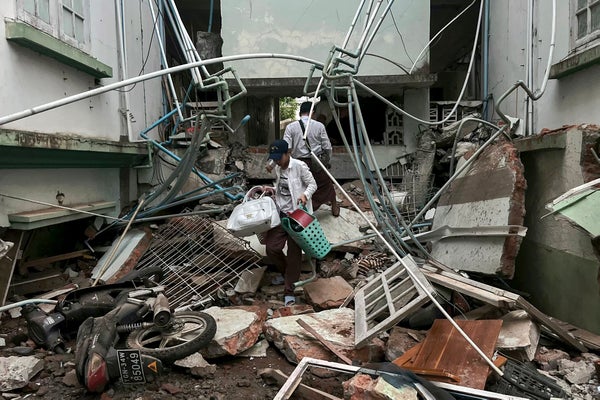
On March 28, at around midday local time, tens of millions of people in Southeast Asia felt the earth below their feet violently rupture. A magnitude 7.7 earthquake, centered just 12 miles away from Mandalay, Myanmar, shook the region—causing streets to buckle, ancient pagodas to crumble, bridges to shatter and houses to collapse. Entire neighborhoods were devastated in a matter of seconds.
The earthquake’s energy release was comparable to that of several hundred nuclear weapon explosions. “The magnitude of this event was so high that it was felt in neighboring countries,” says Amilcar Carrera-Cevallos, an earthquake scientist at the Vicente Rocafuerte Secular University of Guayaquil in Ecuador. A 30-story skyscraper under construction in Bangkok—600 miles from the quake’s epicenter—disintegrated. According to estimates by the U.S. Geological Survey, there will be thousands, if not tens of thousands, of casualties, as well as tens of billions of dollars of economic damage.
Many factors conspired to make this earthquake a disaster, including a lack of quake-proofing measures in buildings across the region. Few of the structures could withstand this monster of a temblor, which was “a really big, shallow earthquake”—meaning it occurred relatively close to the Earth’s surface, says Judith Hubbard, an earthquake scientist at Cornell University.
On supporting science journalism
If you're enjoying this article, consider supporting our award-winning journalism by subscribing. By purchasing a subscription you are helping to ensure the future of impactful stories about the discoveries and ideas shaping our world today.
What caused the Myanmar earthquake?
Around 45 million years ago, the Indian tectonic plate collided with the Eurasian plate before the former started to descend beneath the latter. The crumbled crust in the middle is what we refer to as the Himalayas today. This mountain range, and the entire region, is filled with faults generated by that epic geological pileup. The Indian plate is still very slowly running into Eurasia, and those myriad faults take on a lot of stress as a result. From time to time, they rupture.
The March 28 event was an especially gargantuan rupture along one specific schism. “All available data so far strongly suggest a rupture on the Sagaing Fault,” says Robin Lacassin, an earthquake scientist at the Paris Institute of Earth Physics. This is a major north-south “strike-slip” fault, one in which two blocks of the crust slide past each other (a bit like the San Andreas Fault in California). The Sagaing Fault is “the main strike-slip boundary on that side of the Indian plate,” Lacassin says. And it “has been responsible for many strong and destructive earthquakes in the past.”

Cars pass a damaged road in Naypyidaw on March 28, 2025, after an earthquake in central Myanmar.
Sai Aung Main/AFP via Getty Images
Hubbard points out that, just in May 2023, the very same fault ruptured and generated a magnitude 5.8 temblor, causing a modest degree of destruction. It’s a particularly perilous fault, not least because Nay Pyi Taw, the capital city of Myanmar, lies directly atop it.
Today’s magnitude 7.7 rupture was exponentially more powerful than the 2023 event. Earthquakes are measured on the modified Mercalli intensity scale, which gauges the shaking intensity based on surface observations. Close to the epicenter, nearly a million people felt this quake as IX, or “violent,” on the scale: many buildings weren’t just damaged but also thrown about, with some literally shifted off their foundation.
Slightly farther from the epicenter, the shaking ranked as “severe” or “very strong”—and onlookers in Thailand were shocked to see buildings there receive damage as well. Preliminary data suggest that seismic waves traveled so far from the source because they were channeled along the southern section of the Sagaing Fault. “This would explain the damage in Bangkok and reports that it was felt far away,” Carrera-Cevallos says.
Why was the Myanmar earthquake so damaging?
Earthquakes like this are a horrific reminder of why disasters cannot purely be referred to as “natural.” Today’s quake was powerful, yes—but the cities in the blast zone didn’t stand a chance because of a decidedly human factor. “This earthquake occurred in an area with no earthquake-resistant buildings and inadequate building codes,” Carrera-Cevallos says.
Although you cannot design a building to guarantee that it will hold up against the mightiest of earthquakes, you can fit dampeners into their architecture to allow them to safely “sway” in the event of a temblor. Even older structures can be retrofitted to include various forms of quake-resistant technology.
The damage in Thailand is shocking but is unlikely to be too severe. The shaking there was less intense than in Myanmar, and the high-rise skyscraper that collapsed in Thailand was under construction, so it is probably an outlier. “We can expect much worse in Myanmar,” Hubbard says.
Myanmar’s political situation will work against its recovery efforts. A military coup in 2021 and an ongoing civil war had already displaced millions of people from their homes. This quake is going to dramatically inflate that number, exacerbating an already extensive humanitarian crisis. Strong aftershocks will shake cities, towns and villages for several weeks to come, also impeding the likely chaotic recovery efforts.