
The following essay is reprinted with permission from  The Conversation, an online publication covering the latest research.
It’s rare to feel earthquakes in the U.S. Northeast, so the magnitude 4.8 earthquake in New Jersey that shook buildings in New York City and was felt from Maryland to Boston on April 5, 2024, drew a lot of questions. It was one of the strongest earthquakes on record in New Jersey, though there were no immediate reports of major damage. We asked geoscientist Gary Solar of Buffalo State University to explain what causes earthquakes like this.
What causes earthquakes like this in the US Northeast?
On supporting science journalism
If you're enjoying this article, consider supporting our award-winning journalism by subscribing. By purchasing a subscription you are helping to ensure the future of impactful stories about the discoveries and ideas shaping our world today.
There are many ancient faults in the rocks in that part of New Jersey. They extend through Philadelphia and along the Appalachians, and the other direction, past New York City and into western New England.
These are fractures where gravity can cause the rock on either side to slip, causing the ground to shake. There is no active tectonic plate motion in the area today, but there was about 250 million to 300 million years ago.
The earthquake activity in New Jersey on April 5 is similar to the 3.8 magnitude earthquake that we experienced in 2023 in Buffalo, New York. In both cases, the shaking was from gravitational slip on those ancient structures.
In short, rocks slip a little on steep, preexisting fractures. That’s likely what happened in New Jersey, assuming there was no man-made trigger.
How dangerous is a 4.8 magnitude earthquake?
Magnitude 4.8 is pretty large, but it’s likely to have only minor effects compared with large ones that cause major damage and loss of life.
The scale used to measure earthquakes is logarithmic, so each integer is a factor of 10. That means a magnitude 6 earthquake is 10 times larger than a magnitude 5 earthquake. The bigger ones, like the magnitude 7.4 earthquake in Tawian a few days earlier, are associated with active plate margins, where two tectonic plates meet.
The vulnerability of buildings to a magnitude 4.8 earthquake would depend on the construction. The building codes in places like California are very strict because California has a major plate boundary fault system – the San Andreas system. New Jersey does not, and correspondingly, building codes don’t account for large earthquakes as a result.
How rare are earthquakes in the Northeast, and will New Jersey see more in the same location?
Earthquakes are actually pretty common in the Northeast, but they’re usually so small that few people feel them. The vast majority are magnitude 2.5 or less.
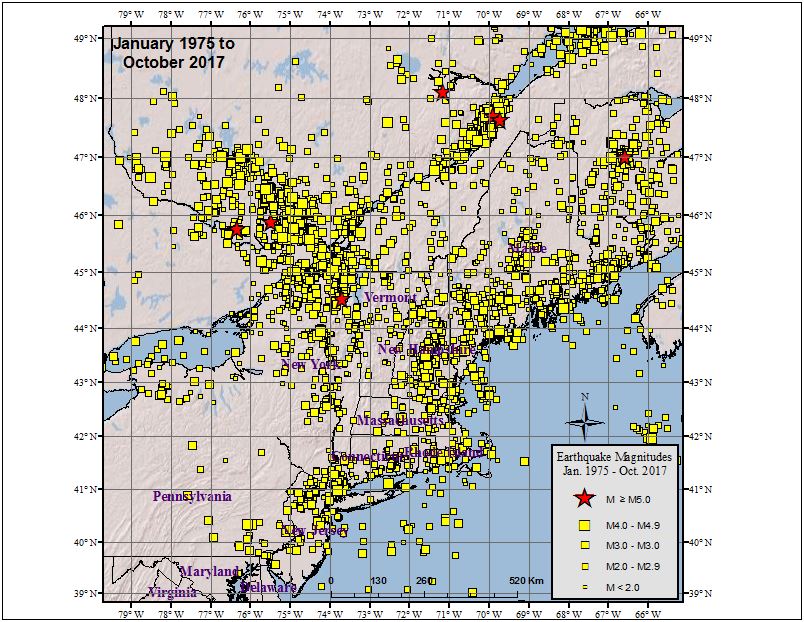
The rare large ones like this are generally not predictable. However, now that this one has happened, there will likely not be others of similar size in that area for a long time. Once the slip happens in a region like this, the gravitational problem on that ancient fault is typically solved and the system is more stable.
That isn’t the case for active plate margins. In those areas, tectonic stresses continually build up, and the earthquakes are caused by a failure to stick.
This article was originally published on The Conversation. Read the original article.