
Keise Izuma, a lecturer in the department of psychology at the University of York in England, replies:
Cognitive dissonance is that uncomfortable feeling you get when you try to maintain two or more inconsistent beliefs at the same time or when you believe one thing but act in a contradictory way. For example, you commit to losing weight and then gorge on cake. The discrepancy can be unnerving, and people will often try to eliminate the dissonance by changing their attitudes. So to feel better about cheating on our diet, we may tell ourselves that we will go for a run tomorrow.
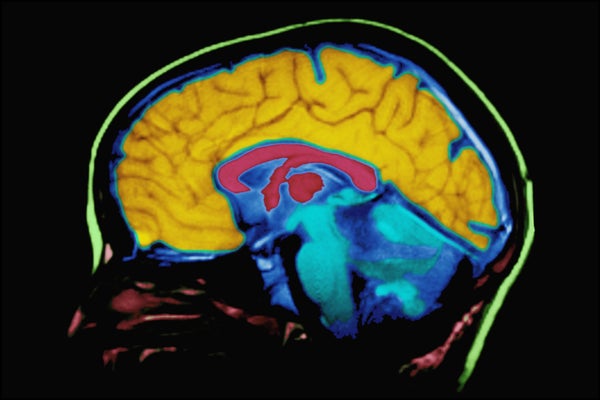
What is the neural explanation for this common type of psychological stress? Thanks to advances in imaging methods, especially functional MRI, researchers have recently identified key brain regions linked to cognitive dissonance. The area implicated most consistently is the posterior part of the medial frontal cortex (pMFC), known to play an important role in avoiding aversive outcomes, a powerful built-in survival instinct. In fMRI studies, when subjects lie to a peer despite knowing that lying is wrong—a task that puts their actions and beliefs in conflict—the pMFC lights up.
On supporting science journalism
If you're enjoying this article, consider supporting our award-winning journalism by subscribing. By purchasing a subscription you are helping to ensure the future of impactful stories about the discoveries and ideas shaping our world today.
Recently my colleagues and I demonstrated a causal link between pMFC activity and the attitude change required to reduce dissonance. We induced cognitive dissonance in 52 participants by having them rate two wallpapers. When asked to evaluate their choices on a second viewing, some participants realized that they had actually rejected their preferred wallpaper, whereas others had initially chosen their least favorite option. We found that by temporarily decreasing activity in the pMFC using a technique called transcranial magnetic stimulation (TMS), we could also diminish their attitude changes and their desire to create consistency.
Additional studies have revealed that cognitive dissonance engages other brain regions, such as the insula and dorsolateral prefrontal cortex (DLPFC). The insula, which processes emotions, often becomes more active when people are upset or angry, and the DLPFC is strongly associated with cognitive control. One study found that disrupting the activity of the DLPFC by zapping it with electrodes reduces the extent to which we try to rationalize our beliefs following cognitive dissonance.
Although people may think cognitive dissonance is a bad thing, it actually helps to keep us mentally healthy and happy. It may make us feel satisfied with our choices—or at least lets us justify them—especially when they cannot be easily reversed. Resolving dissonance may help prevent us from making bad choices or motivate us to make good ones. This desire to be at peace with our decisions might be just the thing to inspire us to go for that run after all.
