
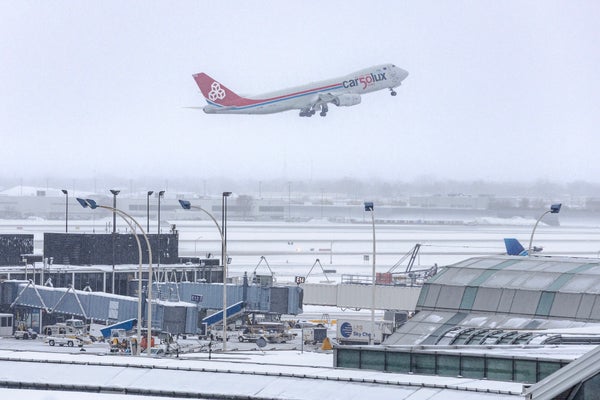
A winter storm that will likely not quite reach “bomb cyclone” status is nonetheless bringing messy weather to the eastern part of the U.S. today, with snow totals of a foot expected in parts of New York State and southern Maine.
This first significant blast of winter weather for the region is thanks to a low-pressure system that has been moving eastward from the Midwest through the Ohio Valley and mid-South over the last few days, says Alan Gerard, a meteorologist and CEO of Balanced Weather. The disturbance is causing a second spot of low pressure to develop off the mid-Atlantic coast. This other low is expected to intensify as it moves north toward Cape Cod over the course of today but will likely stay “just shy of bomb cyclone territory,” says Ashton Robinson Cook, a meteorologist with the National Oceanic and Atmospheric Administration (NOAA) Weather Prediction Center.
A bomb cyclone occurs when a storm in the midlatitudes rapidly drops in pressure within 24 hours. The precise pressure drop depends on the latitude: For example, at 40 degrees latitude (roughly that of New York City), the pressure must drop by about 18 millibars in 24 hours, according to NOAA. The cyclone moving north off the East Coast will still intensify impressively, Cook says, and will bring strong winds to parts of Maine to go along with the snow.
On supporting science journalism
If you're enjoying this article, consider supporting our award-winning journalism by subscribing. By purchasing a subscription you are helping to ensure the future of impactful stories about the discoveries and ideas shaping our world today.
But this low pressure is, however, keeping warmer air near the most populated stretch of the Northeast to the mid-Atlantic, Gerard says. “That’s why Boston through D.C. is pretty much getting rain or a little bit of mixed precipitation,” he says. The heaviest snow, around eight to 12 inches, is expected across southern New England and New York State.
Most of the precipitation will clear out by Wednesday morning, Cook says, though shots of cold air will continue to plunge into the central and eastern U.S. through next weekend. That chilly pattern may well continue throughout December, Gerard says.
Though it’s not always straightforward to link polar patterns to North American weather directly, this winter storm was preceded by an episode of what is called stratospheric warming above the North Pole. This phenomenon happens when the stratosphere—the layer of the atmosphere above the troposphere, where most of our weather occurs—suddenly rises by several degrees in temperature. That warming weakened the polar vortex, the circle of strong winds around the Arctic that keeps the coldest air fenced in around the pole. When it weakens, it can cause cold air to bleed southward. A second wobble of the polar vortex may kick up in the next couple of weeks, Gerard says.