
Theodore G. Lindeman, professor and chair of the chemistry department of Colorado College in Colorado Springs, offers this explanation:
The physical principle known as Charles' law states that the volume of a gas equals a constant value multiplied by its temperature as measured on the Kelvin scale (zero Kelvin corresponds to -273.15 degrees Celsius).
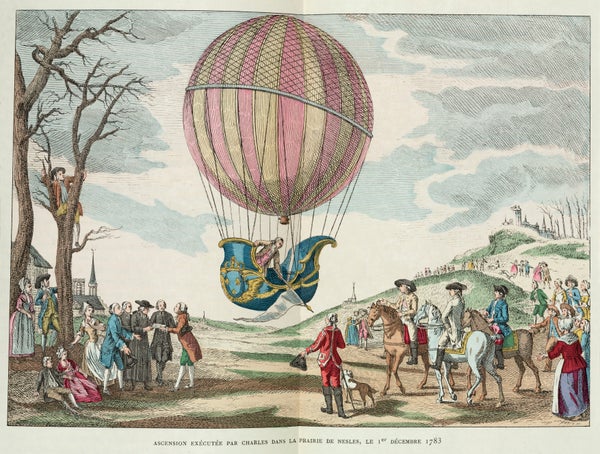
The law's name honors the pioneer balloonist Jacques Charles, who in 1787 did experiments on how the volume of gases depended on temperature. The irony is that Charles never published the work for which he is remembered, nor was he the first or last to make this discovery. In fact, Guillaume Amontons had done the same sorts of experiments 100 years earlier, and it was Joseph Gay-Lussac in 1808 who made definitive measurements and published results showing that every gas he tested obeyed this generalization.
On supporting science journalism
If you're enjoying this article, consider supporting our award-winning journalism by subscribing. By purchasing a subscription you are helping to ensure the future of impactful stories about the discoveries and ideas shaping our world today.
It is pretty surprising that dozens of different substances should behave exactly alike, as these scientists found that various gases did. The accepted explanation, which James Clerk Maxwell put forward around 1860, is that the amount of space a gas occupies depends purely on the motion of the gas molecules. Under typical conditions, gas molecules are very far from their neighbors, and they are so small that their own bulk is negligible. They push outward on flasks or pistons or balloons simply by bouncing off those surfaces at high speed. Inside a helium balloon, about 1024 (a million million million million) helium atoms smack into each square centimeter of rubber every second, at speeds of about a mile per second!
Both the speed and frequency with which the gas molecules ricochet off container walls depend on the temperature, which is why hotter gases either push harder against the walls (higher pressure) or occupy larger volumes (a few fast molecules can occupy the space of many slow molecules). Specifically, if we double the Kelvin temperature of a rigidly contained gas sample, the number of collisions per unit area per second increases by the square root of 2, and on average the momentum of those collisions increases by the square root of 2. So the net effect is that the pressure doubles if the container doesn't stretch, or the volume doubles if the container enlarges to keep the pressure from rising.
So we could say that Charles' Law describes how hot air balloons get light enough to lift off, and why a temperature inversion prevents convection currents in the atmosphere, and how a sample of gas can work as an absolute thermometer.