
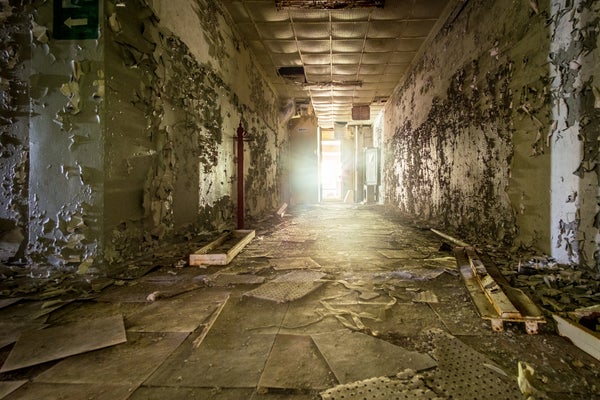

Eerie images from the site of the Chernobyl nuclear disaster still haunt us 30 years later. What is Chernobyl like today?
On April 26, 1986, a safety test gone wrong led to an explosion in reactor #4 at the Chernobyl Nuclear Power Plant in Pripyat, Ukraine. (At the time, Pripyat was part of the USSR.) Several factors then conspired to result in an unprecedented, widespread scattering of over 100 radioactive elements into the surrounding towns and cities.
On supporting science journalism
If you're enjoying this article, consider supporting our award-winning journalism by subscribing. By purchasing a subscription you are helping to ensure the future of impactful stories about the discoveries and ideas shaping our world today.
First off, RBMK reactors, like the ones at Chernobyl, don’t have containment structures like concrete and steel domes. Second, the fire resulting from the explosion burned for almost ten days and further destroyed the building surrounding the reactor. And finally, once air was able to enter the core of the reactor, graphite blocks, meant to moderate reactions in a working reactor, also caught fire.
In the hours, days, and weeks after the explosion, radioactive elements including plutonium, iodine, strontium, and caesium contaminated a region of roughly 150,000 square kilometers in Belarus, Russia, and Ukraine. Carried by the wind, these elements were later detected as far away as Sweden and Finland and across the northern hemisphere.
Pripyat and the Chernobyl Exclusion Zone
The entire population of Pripyat, home to about 50,000 people and only three kilometers (about 1.8 miles) away, was evacuated. But the evacuation didn't happen until 36 hours after the explosion. Many didn't understand the magnitude of the disaster and thought they’d only be gone for a few days. They were not permitted to bring many belongings, including family pets, for fear of contamination. Their hasty exit left a town that today appears frozen in time: a doll lying atop rusted playground equipment, supermarkets taken over by nature, and a ferris wheel stopped for good.
In the weeks and months that followed the explosion, an estimated 120,000 to 200,000 people in total were evacuated across a region known as the Chernobyl Exclusion Zone, which covers everything within a 30 kilometer radius of the site, or roughly 1000 square miles.
The region is expected to remain uninhabitable for thousands of years. Many of the radioactive elements decayed quickly, but the most dangerous—iodine-131, strontium-90, and cesium-137—have half-lives of 8 days, 29 years, and 30 years, respectively. In chemistry, the definition of a half-life says that this means it will take 30 years for half of the initial cesium to decay. Then, it will take another 30 years for half of what you had left at the 30-year mark to decay. But in studying Chernobyl, scientists have learned that the “ecological half-life” of cesium—that’s how long it takes for the element to actually disappear from the local environment—is turning out to be much longer. While contamination in the water supply has improved, the levels of radioactivity in the soil remain higher than the 30-year half-life would predict.
»Continue reading “What Is Chernobyl Like Today?” on QuickAndDirtyTips.com