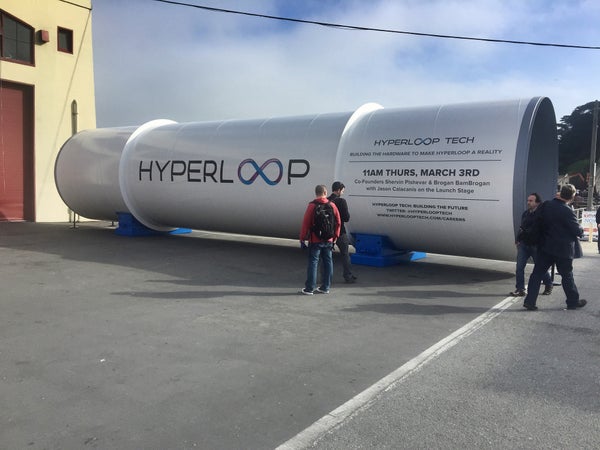
What Is the Hyperloop?

The internet has been buzzing with news of the first Hyperloop test. But what, exactly, is the hyperloop?

Join Our Community of Science Lovers!


Let’s first take a 10,000 foot view of what exactly the Hyperloop is. In 2013, Elon Musk first made his idea of the Hyperloop public. If you recognize that name, that’s because I’ve mentioned him in my podcast on the Tesla Powerwall. He’s the founder of many tech giants, such as Tesla, PayPal, SpaceX, and zip2. He’s a pretty extraordinary billionaire, which I’m sure we will see much more of in the years to come.

The Hyperloop is similar to the small vacuum tubes that can be found at banks and retail stores that are often used to move money quickly in sealed containers. Now if you’re not sure what I’m talking about, I’ve posted a link in the show notes to one of these small vacuum tubes working. Now the concept is to make the tubes and capsules much larger in order to carry passengers and maybe even other vehicles.


On supporting science journalism

If you're enjoying this article, consider supporting our award-winning journalism by subscribing. By purchasing a subscription you are helping to ensure the future of impactful stories about the discoveries and ideas shaping our world today.


Instead of using just air pressure alone to move, the Hyperloop will have similar technology to bullet trains that use magnets to propel themselves forward. The tube that the Hyperloop will travel through will have some of the air pumped out of it. This will allow the capsule to travel through much more easily without having to deal with a significant amount of air pressure.

»Continue reading on QuickAndDirtyTips.com

It’s Time to Stand Up for Science

If you enjoyed this article, I’d like to ask for your support. Scientific American has served as an advocate for science and industry for 180 years, and right now may be the most critical moment in that two-century history.

I’ve been a Scientific American subscriber since I was 12 years old, and it helped shape the way I look at the world. SciAm always educates and delights me, and inspires a sense of awe for our vast, beautiful universe. I hope it does that for you, too.

If you subscribe to Scientific American, you help ensure that our coverage is centered on meaningful research and discovery; that we have the resources to report on the decisions that threaten labs across the U.S.; and that we support both budding and working scientists at a time when the value of science itself too often goes unrecognized.

In return, you get essential news, captivating podcasts, brilliant infographics, can't-miss newsletters, must-watch videos, challenging games, and the science world's best writing and reporting. You can even gift someone a subscription.

There has never been a more important time for us to stand up and show why science matters. I hope you’ll support us in that mission.

Thank you,

David M. Ewalt, Editor in Chief, Scientific American

Subscribe